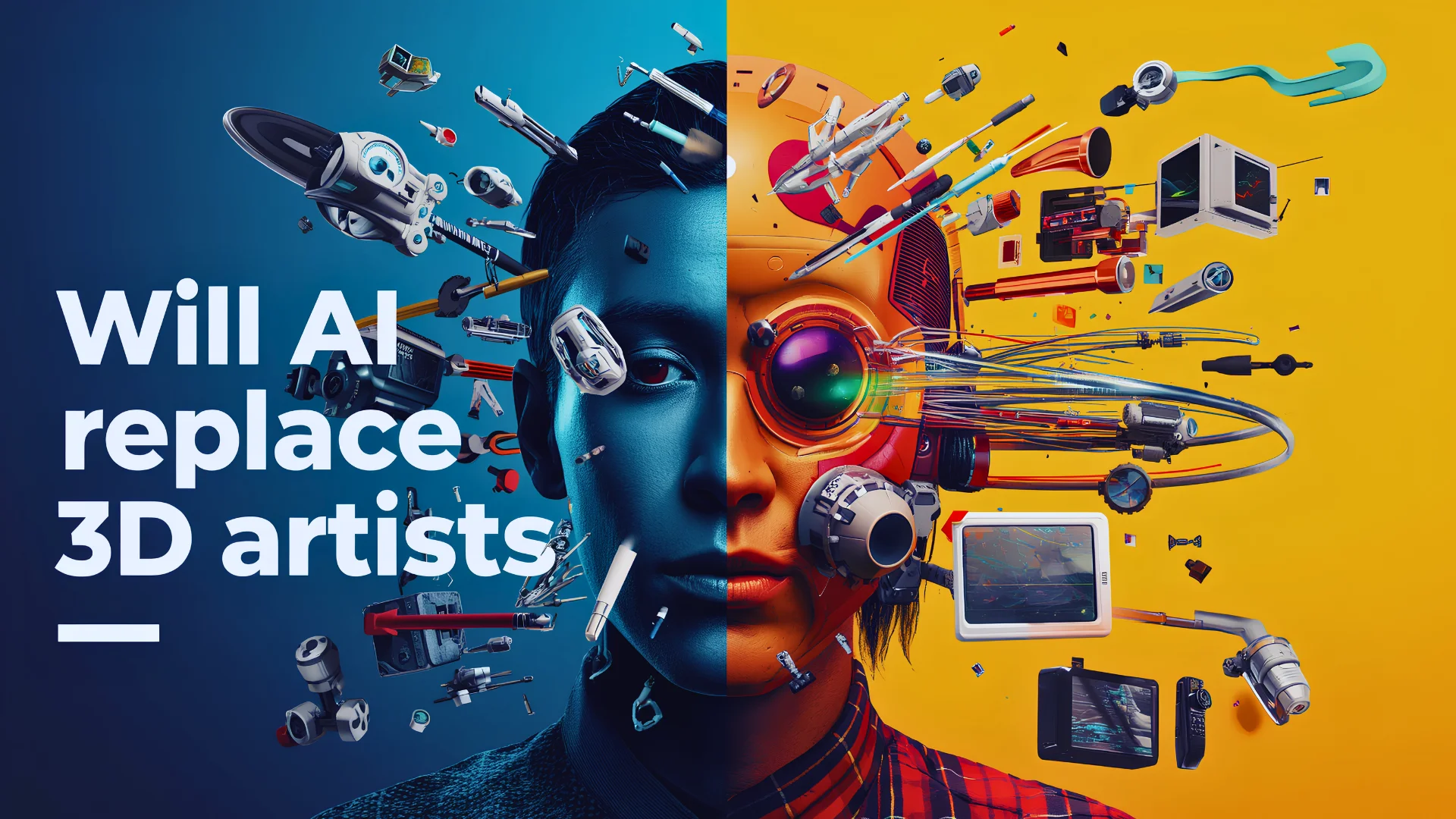
Let's not start with the usual reassuring line - 'AI won't replace artists, it'll just be a tool!' That may ultimately be true, but the situation on the ground in 2025–2026 is messier, more nuanced, and in some pockets, genuinely alarming. Some 3D artists have already lost work. Others are thriving. The difference depends almost entirely on what kind of work they do.
This article is built on real data. It does not sugarcoat the hard numbers, but it also does not catastrophise. Here is an honest breakdown of where AI currently stands, which segments of the 3D art industry are most at risk, and what the evidence suggests about the path forward.
1. The Numbers: What the Job Data Actually Shows
The clearest signal comes from a January 2026 analysis of 180 million job postings by Bloomberry. Among the top ten declining job roles, three are creative positions. The numbers are stark:
~33% Decline in computer graphics artist job postings (2024 → 2025) |
That 33% figure covers roles described as technical artists, 3D artists, and VFX artists. To put this in context, the overall job market declined by about 8% in 2025. Computer graphics artists are being hit more than four times harder than the average profession.
A separate 2025 GDC State of the Game Industry report found that 58% of game developers expressed worry about future layoffs, with prolonged unemployment being a common experience for those already let go. In the VFX world, an industry report from early 2026 described freelance employment as 'uneven', pipelines are filling again post-2023 strikes, but freelancers are not being rehired at the same rates.
One particularly honest account came from a freelance 3D/2D generalist who had spent a decade producing supplemental graphics and animated B-roll for documentary television. By late 2025, they described that market as having completely dried up, not because their skills declined, because studios upstream were replaced by AI pipelines, taking dozens of downstream artists with them.
⚠️ The Honest Reality Entry-level and mid-tier repetitive work - background environments, generic props, B-roll animation, stock-style assets, is where AI displacement is happening now. This is not speculation. These jobs are disappearing. |
2. What AI Can Actually Do in 3D Today (2026)
To understand the threat and the opportunity accurately, you need to know what the tools are genuinely capable of. As of 2026, the leading platforms are:
Text-to-3D and Image-to-3D Generation
Tools like Tripo AI, Meshy, Luma AI, and Rodin (Hyper3D) can now generate 3D meshes from a text prompt or a single image in seconds to minutes. Tripo's v3.0 model produces meshes up to 2 million polygons with 4K texture maps. Generation time is around 20 seconds for standard models.
However, these outputs consistently require retopology, rigging, and professional polish before they are production-ready. Luma AI in particular produces visually impressive results that almost always need retopology before they can be used in a game engine. This gap between 'generated' and 'production-ready' is where human artists remain essential, for now.
Auto-Rigging and Animation
Meshy currently leads in pipeline automation, offering built-in auto-rigging and over 500 animation presets. Tripo and Luma do not offer native rigging, meaning character assets from those tools require a separate rigging step in Blender or a dedicated service. Full pipeline automation, text prompt to animation-ready game asset, is still a multi-tool workflow, not a single-click solution.
AI Denoising and Render Acceleration
Intel's OIDN (Open Image Denoise) received a Technical Achievement Award from the Academy of Motion Picture Arts and Sciences in 2025, a clear signal that AI denoising has reached production scale. In practice, AI denoising reduces required render samples by 80–90%, translating to 40–60% faster render times on production jobs. This is not a threat to artists, it is a direct productivity multiplier.
Concept Generation and Previs
Stable Diffusion XL and Midjourney are now standard tools in architectural visualisation and game previs pipelines. They accelerate the ideation phase dramatically. A process that once required days of concept sketching and rough 3D blockouts can now produce dozens of direction options in hours. The work of a concept artist is changing faster than that of a technical 3D modeller.
Cost Reduction Figures
Studies from game studios indicate that 3D modelling costs can be reduced by 60–80% when AI-assisted workflows are applied to environmental assets and background elements. This is the economic incentive driving studio adoption, and it is exactly why lower-tier generalist roles are being cut.
3. What AI Still Cannot Do - And Where It Consistently Fails
The nuanced truth is that AI has clear and significant limitations in 3D art - limitations that are not marketing spin but observable failure modes that professionals encounter daily.
Art Direction and Creative Vision
A prediction from industry analysts at Creative Bloq in late 2025 put it clearly: AI cannot easily perform strong art direction, creative vision, emotional storytelling, or design unique intellectual property. This observation is backed by studio practice, game studios still rely on human concept artists to establish creative direction before AI tools are introduced into the pipeline. Without that human creative anchor, AI produces visually competent but directionless output.
Brand Precision and Consistency
Companies invest heavily in precise brand identities - exact colours, specific material finishes, logo geometry down to fractions of a millimetre for product visualisation. AI generation hallucinates details and cannot reliably reproduce brand-consistent assets. For product visualisation studios, this makes AI-only pipelines unsuitable for client-facing deliverables without significant human intervention.
Complex Technical Problem-Solving
Real production 3D work involves unexpected problems - a rig breaking at a specific frame, a shader behaving incorrectly under certain lighting conditions, a character mesh deforming badly in a corner case pose. AI systems are bounded by their training data. They cannot reason through novel technical or artistic problems they have not encountered before. Human artists improvise, adapt, and solve problems laterally. AI cannot.
Emotional Nuance and Narrative Authenticity
AI has no innate sense of style or taste. It produces art based on pattern recognition across training data - essentially a very sophisticated average of what it has seen. Producing a character that conveys grief authentically, or designing an environment that feels culturally specific and lived-in, requires human life experience, cultural literacy, and emotional intelligence that current AI architectures do not possess.
Unique Intellectual Property
Creating genuinely original characters, worlds, and visual languages, the kind of IP that builds franchises, remains deeply human work. AI can remix and recombine existing styles, but designing something that has never existed and feels coherent, original, and emotionally resonant is where human artists are irreplaceable at any meaningful level of creative ambition.
💡 The Hard Truth About AI Limitations AI is extraordinarily good at producing the 'average' of what already exists. Original creative vision, brand precision, and production problem-solving require human artists. The further a project is from 'generic', the less useful pure AI generation becomes. |
4. Who Is Most at Risk - And Who Is Most Insulated
Not all 3D artists face the same level of disruption. The risk varies significantly depending on the type of work.

Highest Risk
Entry-level generalists producing generic assets - stock props, background environments, filler animations. This work is already being automated.
Freelancers in commoditised markets - documentary B-roll, low-budget game asset libraries, generic product renders for e-commerce.
Concept artists doing early-stage exploration - AI is fastest at generating rough explorations, which is the first thing cut when budgets tighten.
Texture and material artists working on non-branded generic materials - tools like Adobe Substance 3D AI features are accelerating this heavily.
Moderate Risk (Transitioning)
Mid-level environment artists - AI assists with base mesh generation and texture, but layout, composition, and gameplay-specific design remain human.
Character modellers - base mesh generation is increasingly AI-assisted, but rigging, facial performance, and hero character work still needs human expertise.
Lowest Risk (Most Insulated)
Senior art directors and creative directors - the demand for vision, direction, and final quality judgment is growing, not shrinking.
Technical artists and pipeline TDs - integrating AI tools into production pipelines requires deep technical expertise. This role is actively growing.
VFX artists working on hero assets and simulation - complex simulations, destruction, fluid dynamics, and hero character work remain firmly human.
IP creators with a distinct personal style - artists whose work is identifiably theirs are harder to commoditise.
✅ The Harvard HBS Research Finding A 2026 Harvard Business School working paper found that after ChatGPT's launch, job postings for structured and repetitive tasks fell 13%, but demand for jobs requiring analytical, technical, or creative work grew 20%. The direction matters more than the label. |
5. The Uncomfortable Counterpoint: The Industry Is Still Growing
Here is the data point that the doom narrative often ignores: the global 3D rendering market is projected to grow from USD 4.30 billion in 2025 to USD 13.92 billion by 2031, a compound annual growth rate of approximately 21.6%. This is not a dying industry. It is an expanding one.
Demand for 3D content is rising across streaming platforms, AR/VR, gaming, e-commerce, architectural visualisation, and product marketing. The total volume of 3D work being created globally is increasing, not decreasing. What is shifting is the labour structure - fewer humans needed per unit of output, but more total output being demanded.
The 3D animation job market, despite near-term turbulence from layoffs and AI displacement, is projected to recover toward the end of 2025–2026 according to industry analysts, driven by streaming platform expansion and immersive technology growth. The industry is not contracting. It is restructuring.
This means the painful reality for many individual artists coexists with genuine opportunity - for those positioned on the right side of the transition.
6. What Studios Are Actually Doing Right Now
The 2025 GDC survey revealed a telling divide: while AI-assisted 3D modelling and task automation were recognised for their potential, the most common response from developers about AI usage was simply 'none.' Thirty per cent of developers said they believed AI has a negative impact on the industry, a twelve-point increase from 2024. Ethical concerns, intellectual property questions, and job displacement were the primary concerns cited.
But this resistance is softening. Creative Bloq's industry analysis from late 2025 was explicit: 'The industry's quiet resistance to AI ends this year.' Autodesk has been embedding AI into its core tools throughout 2025 and into 2026. The hybrid workflow, where a 3D artist maintains creative control while AI handles base generation, texturing, and retopology, is becoming the dominant model in mid-to-large studios.
Smaller studios and freelancers face a different dynamic. Reduced budgets mean reduced tolerance for manual workflows that AI can approximate. The freelance market for lower-tier generalist work is the most exposed.
7. The Honest Verdict
Will AI replace 3D artists? The answer depends entirely on which 3D artists you are asking about.
For entry-level generalists doing repetitive asset work:
The displacement is already happening. Job postings dropped 33% in 2025. This is not a future concern, it is a present reality. Artists in this segment need to develop higher-level skills or shift into AI pipeline management, technical direction, or creative direction roles. Staying still is not an option.
For mid-level specialists:
The next two to four years will be turbulent but survivable, for those who actively learn AI tools and integrate them into their workflows. The artists who resist AI entirely are taking the biggest risk. The artists who treat AI as a threat to be feared will be outcompeted by artists who treat it as a multiplier to be mastered.
For senior artists, art directors, and creative leads:
Demand for vision, direction, and quality judgement is growing. AI increases the volume of content being produced, which increases the need for experienced professionals who can tell good from mediocre, and guide junior teams toward the former. This layer of the industry is, counterintuitively, benefiting from AI.
For the craft itself:
3D art is not dying. It is becoming faster, more accessible, and more technically complex simultaneously. The market for high-quality, original, direction-driven 3D work is growing. The market for generic, interchangeable output is being automated. This is the central tension of the next decade in creative industries, and it is not unique to 3D art.
📌 The One-Line Summary AI is replacing the least skilled work in 3D art, transforming the mid-level, and amplifying the value of the most skilled. The artists who understand this distinction, and position themselves accordingly, have a stronger career ahead than they did five years ago. |
8. What Should a 3D Artist Actually Do?
Given everything above, here are practical, research-grounded directions, not platitudes.
Understand Tripo, Meshy, and Luma AI. Understand their outputs and their failure modes. An artist who can generate a base mesh in 20 seconds, identify its topology problems, fix them in Blender, and deliver a polished result in an hour is more valuable than an artist who spends four hours on the same base mesh without AI.
Move up the value chain
The skills that AI cannot replicate - art direction, narrative design, creative vision, client communication, pipeline problem-solving, are the skills worth investing in. Every hour spent learning to be a better art director is a better investment right now than an hour spent optimising skills that AI is automating.
Develop a recognisable style or specialisation
Generic artists producing generic work are the most substitutable. Artists known for a specific visual language, a technical specialisation, or a category of work they do exceptionally well are far harder to replace. Niche depth is more protective than broad generalism in an AI-saturated market.
Understand the pipeline, not just the craft
Technical Director and pipeline roles are among the fastest growing in the VFX and game industries. An artist who understands how AI tools fit into a production pipeline, and can build, optimise, and troubleshoot that pipeline, is increasingly valuable. The skill gap here is wide, and the reward for closing it is significant.
Do not wait
The 2025 GDC data showed that 30% of developers believe AI has a negative impact, up twelve points in a year. Sentiment is shifting fast. The artists who spent 2023 and 2024 watching and waiting are now behind those who spent those years learning and adapting. 2026 is not too late, but it is not early either.
Final Thought
Every major technology shift in the history of art and media, photography, digital editing, 3D software itself, was met with the same fear: that the craft would die and artists would be replaced. In each case, the craft changed, the tools changed, and the number of people working in the field eventually grew. AI will not be an exception to this pattern.
What is different this time is the speed. Previous transitions played out over decades. This one is playing out in years. That speed is real, the displacement for some is real, and the urgency to adapt is real. But the underlying demand for human creative vision, the kind that only comes from lived experience, emotional intelligence, and genuine originality, has not gone anywhere.
The 3D artists who will thrive are not the ones who are most talented with a mouse and keyboard. They are the ones who understand this moment clearly and adapt deliberately.
Sources & Research Basis
Bloomberry (January 2026) - Analysis of 180M job postings: 33% decline in computer graphics artist roles (2024 - 2025)
GDC State of the Game Industry 2025 - Developer survey on AI sentiment, layoff concern, usage patterns
Harvard Business School Working Paper (February 2026) - AI impact on labour market by job type
SuperRenders VFX Industry Trends 2026 - 3D rendering market size projections, AI denoising production data
Creative Bloq (December 2025 / 2026) - Industry expert analysis on 3D artist futures and AI adoption
KeyShot Expert Interviews (2025) - Testimonials from professional 3D artists and educators on AI's industry impact
Meshy / Tripo / Luma AI product documentation (2025 - 2026) - Capabilities benchmarks, tool comparisons
Blood in the Machine (September 2025) - First-person accounts from displaced 3D artists
ESMA 3D Animation Job Market Analysis (2025) - Cyclical recovery projections, streaming-driven demand



Let's not start with the usual reassuring line - 'AI won't replace artists, it'll just be a tool!' That may ultimately be true, but the situation on the ground in 2025–2026 is messier, more nuanced, and in some pockets, genuinely alarming. Some 3D artists have already lost work. Others are thriving. The difference depends almost entirely on what kind of work they do.
This article is built on real data. It does not sugarcoat the hard numbers, but it also does not catastrophise. Here is an honest breakdown of where AI currently stands, which segments of the 3D art industry are most at risk, and what the evidence suggests about the path forward.
1. The Numbers: What the Job Data Actually Shows
The clearest signal comes from a January 2026 analysis of 180 million job postings by Bloomberry. Among the top ten declining job roles, three are creative positions. The numbers are stark:
~33%
Decline in computer graphics artist job postings (2024 → 2025)
That 33% figure covers roles described as technical artists, 3D artists, and VFX artists. To put this in context, the overall job market declined by about 8% in 2025. Computer graphics artists are being hit more than four times harder than the average profession.
A separate 2025 GDC State of the Game Industry report found that 58% of game developers expressed worry about future layoffs, with prolonged unemployment being a common experience for those already let go. In the VFX world, an industry report from early 2026 described freelance employment as 'uneven', pipelines are filling again post-2023 strikes, but freelancers are not being rehired at the same rates.
One particularly honest account came from a freelance 3D/2D generalist who had spent a decade producing supplemental graphics and animated B-roll for documentary television. By late 2025, they described that market as having completely dried up, not because their skills declined, because studios upstream were replaced by AI pipelines, taking dozens of downstream artists with them.
⚠️ The Honest Reality
Entry-level and mid-tier repetitive work - background environments, generic props, B-roll animation, stock-style assets, is where AI displacement is happening now. This is not speculation. These jobs are disappearing.
2. What AI Can Actually Do in 3D Today (2026)
To understand the threat and the opportunity accurately, you need to know what the tools are genuinely capable of. As of 2026, the leading platforms are:
Text-to-3D and Image-to-3D Generation
Tools like Tripo AI, Meshy, Luma AI, and Rodin (Hyper3D) can now generate 3D meshes from a text prompt or a single image in seconds to minutes. Tripo's v3.0 model produces meshes up to 2 million polygons with 4K texture maps. Generation time is around 20 seconds for standard models.
However, these outputs consistently require retopology, rigging, and professional polish before they are production-ready. Luma AI in particular produces visually impressive results that almost always need retopology before they can be used in a game engine. This gap between 'generated' and 'production-ready' is where human artists remain essential, for now.
Auto-Rigging and Animation
Meshy currently leads in pipeline automation, offering built-in auto-rigging and over 500 animation presets. Tripo and Luma do not offer native rigging, meaning character assets from those tools require a separate rigging step in Blender or a dedicated service. Full pipeline automation, text prompt to animation-ready game asset, is still a multi-tool workflow, not a single-click solution.
AI Denoising and Render Acceleration
Intel's OIDN (Open Image Denoise) received a Technical Achievement Award from the Academy of Motion Picture Arts and Sciences in 2025, a clear signal that AI denoising has reached production scale. In practice, AI denoising reduces required render samples by 80–90%, translating to 40–60% faster render times on production jobs. This is not a threat to artists, it is a direct productivity multiplier.
Concept Generation and Previs
Stable Diffusion XL and Midjourney are now standard tools in architectural visualisation and game previs pipelines. They accelerate the ideation phase dramatically. A process that once required days of concept sketching and rough 3D blockouts can now produce dozens of direction options in hours. The work of a concept artist is changing faster than that of a technical 3D modeller.
Cost Reduction Figures
Studies from game studios indicate that 3D modelling costs can be reduced by 60–80% when AI-assisted workflows are applied to environmental assets and background elements. This is the economic incentive driving studio adoption, and it is exactly why lower-tier generalist roles are being cut.
3. What AI Still Cannot Do - And Where It Consistently Fails
The nuanced truth is that AI has clear and significant limitations in 3D art - limitations that are not marketing spin but observable failure modes that professionals encounter daily.
Art Direction and Creative Vision
A prediction from industry analysts at Creative Bloq in late 2025 put it clearly: AI cannot easily perform strong art direction, creative vision, emotional storytelling, or design unique intellectual property. This observation is backed by studio practice, game studios still rely on human concept artists to establish creative direction before AI tools are introduced into the pipeline. Without that human creative anchor, AI produces visually competent but directionless output.
Brand Precision and Consistency
Companies invest heavily in precise brand identities - exact colours, specific material finishes, logo geometry down to fractions of a millimetre for product visualisation. AI generation hallucinates details and cannot reliably reproduce brand-consistent assets. For product visualisation studios, this makes AI-only pipelines unsuitable for client-facing deliverables without significant human intervention.
Complex Technical Problem-Solving
Real production 3D work involves unexpected problems - a rig breaking at a specific frame, a shader behaving incorrectly under certain lighting conditions, a character mesh deforming badly in a corner case pose. AI systems are bounded by their training data. They cannot reason through novel technical or artistic problems they have not encountered before. Human artists improvise, adapt, and solve problems laterally. AI cannot.
Emotional Nuance and Narrative Authenticity
AI has no innate sense of style or taste. It produces art based on pattern recognition across training data - essentially a very sophisticated average of what it has seen. Producing a character that conveys grief authentically, or designing an environment that feels culturally specific and lived-in, requires human life experience, cultural literacy, and emotional intelligence that current AI architectures do not possess.
Unique Intellectual Property
Creating genuinely original characters, worlds, and visual languages, the kind of IP that builds franchises, remains deeply human work. AI can remix and recombine existing styles, but designing something that has never existed and feels coherent, original, and emotionally resonant is where human artists are irreplaceable at any meaningful level of creative ambition.
💡 The Hard Truth About AI Limitations
AI is extraordinarily good at producing the 'average' of what already exists. Original creative vision, brand precision, and production problem-solving require human artists. The further a project is from 'generic', the less useful pure AI generation becomes.
4. Who Is Most at Risk - And Who Is Most Insulated
Not all 3D artists face the same level of disruption. The risk varies significantly depending on the type of work.
Highest Risk
Entry-level generalists producing generic assets - stock props, background environments, filler animations. This work is already being automated.
Freelancers in commoditised markets - documentary B-roll, low-budget game asset libraries, generic product renders for e-commerce.
Concept artists doing early-stage exploration - AI is fastest at generating rough explorations, which is the first thing cut when budgets tighten.
Texture and material artists working on non-branded generic materials - tools like Adobe Substance 3D AI features are accelerating this heavily.
Moderate Risk (Transitioning)
Mid-level environment artists - AI assists with base mesh generation and texture, but layout, composition, and gameplay-specific design remain human.
Character modellers - base mesh generation is increasingly AI-assisted, but rigging, facial performance, and hero character work still needs human expertise.
Lowest Risk (Most Insulated)
Senior art directors and creative directors - the demand for vision, direction, and final quality judgment is growing, not shrinking.
Technical artists and pipeline TDs - integrating AI tools into production pipelines requires deep technical expertise. This role is actively growing.
VFX artists working on hero assets and simulation - complex simulations, destruction, fluid dynamics, and hero character work remain firmly human.
IP creators with a distinct personal style - artists whose work is identifiably theirs are harder to commoditise.
✅ The Harvard HBS Research Finding
A 2026 Harvard Business School working paper found that after ChatGPT's launch, job postings for structured and repetitive tasks fell 13%, but demand for jobs requiring analytical, technical, or creative work grew 20%. The direction matters more than the label.
5. The Uncomfortable Counterpoint: The Industry Is Still Growing
Here is the data point that the doom narrative often ignores: the global 3D rendering market is projected to grow from USD 4.30 billion in 2025 to USD 13.92 billion by 2031, a compound annual growth rate of approximately 21.6%. This is not a dying industry. It is an expanding one.
Demand for 3D content is rising across streaming platforms, AR/VR, gaming, e-commerce, architectural visualisation, and product marketing. The total volume of 3D work being created globally is increasing, not decreasing. What is shifting is the labour structure - fewer humans needed per unit of output, but more total output being demanded.
The 3D animation job market, despite near-term turbulence from layoffs and AI displacement, is projected to recover toward the end of 2025–2026 according to industry analysts, driven by streaming platform expansion and immersive technology growth. The industry is not contracting. It is restructuring.
This means the painful reality for many individual artists coexists with genuine opportunity - for those positioned on the right side of the transition.
6. What Studios Are Actually Doing Right Now
The 2025 GDC survey revealed a telling divide: while AI-assisted 3D modelling and task automation were recognised for their potential, the most common response from developers about AI usage was simply 'none.' Thirty per cent of developers said they believed AI has a negative impact on the industry, a twelve-point increase from 2024. Ethical concerns, intellectual property questions, and job displacement were the primary concerns cited.
But this resistance is softening. Creative Bloq's industry analysis from late 2025 was explicit: 'The industry's quiet resistance to AI ends this year.' Autodesk has been embedding AI into its core tools throughout 2025 and into 2026. The hybrid workflow, where a 3D artist maintains creative control while AI handles base generation, texturing, and retopology, is becoming the dominant model in mid-to-large studios.
Smaller studios and freelancers face a different dynamic. Reduced budgets mean reduced tolerance for manual workflows that AI can approximate. The freelance market for lower-tier generalist work is the most exposed.
7. The Honest Verdict
Will AI replace 3D artists? The answer depends entirely on which 3D artists you are asking about.
For entry-level generalists doing repetitive asset work:
The displacement is already happening. Job postings dropped 33% in 2025. This is not a future concern, it is a present reality. Artists in this segment need to develop higher-level skills or shift into AI pipeline management, technical direction, or creative direction roles. Staying still is not an option.
For mid-level specialists:
The next two to four years will be turbulent but survivable, for those who actively learn AI tools and integrate them into their workflows. The artists who resist AI entirely are taking the biggest risk. The artists who treat AI as a threat to be feared will be outcompeted by artists who treat it as a multiplier to be mastered.
For senior artists, art directors, and creative leads:
Demand for vision, direction, and quality judgement is growing. AI increases the volume of content being produced, which increases the need for experienced professionals who can tell good from mediocre, and guide junior teams toward the former. This layer of the industry is, counterintuitively, benefiting from AI.
For the craft itself:
3D art is not dying. It is becoming faster, more accessible, and more technically complex simultaneously. The market for high-quality, original, direction-driven 3D work is growing. The market for generic, interchangeable output is being automated. This is the central tension of the next decade in creative industries, and it is not unique to 3D art.
📌 The One-Line Summary
AI is replacing the least skilled work in 3D art, transforming the mid-level, and amplifying the value of the most skilled. The artists who understand this distinction, and position themselves accordingly, have a stronger career ahead than they did five years ago.
8. What Should a 3D Artist Actually Do?
Given everything above, here are practical, research-grounded directions, not platitudes.
Learn the AI tools, not to be replaced by them, but to outpace those who use them uncritically
Understand Tripo, Meshy, and Luma AI. Understand their outputs and their failure modes. An artist who can generate a base mesh in 20 seconds, identify its topology problems, fix them in Blender, and deliver a polished result in an hour is more valuable than an artist who spends four hours on the same base mesh without AI.
Move up the value chain
The skills that AI cannot replicate - art direction, narrative design, creative vision, client communication, pipeline problem-solving, are the skills worth investing in. Every hour spent learning to be a better art director is a better investment right now than an hour spent optimising skills that AI is automating.
Develop a recognisable style or specialisation
Generic artists producing generic work are the most substitutable. Artists known for a specific visual language, a technical specialisation, or a category of work they do exceptionally well are far harder to replace. Niche depth is more protective than broad generalism in an AI-saturated market.
Understand the pipeline, not just the craft
Technical Director and pipeline roles are among the fastest growing in the VFX and game industries. An artist who understands how AI tools fit into a production pipeline, and can build, optimise, and troubleshoot that pipeline, is increasingly valuable. The skill gap here is wide, and the reward for closing it is significant.
Do not wait
The 2025 GDC data showed that 30% of developers believe AI has a negative impact, up twelve points in a year. Sentiment is shifting fast. The artists who spent 2023 and 2024 watching and waiting are now behind those who spent those years learning and adapting. 2026 is not too late, but it is not early either.
Final Thought
Every major technology shift in the history of art and media, photography, digital editing, 3D software itself, was met with the same fear: that the craft would die and artists would be replaced. In each case, the craft changed, the tools changed, and the number of people working in the field eventually grew. AI will not be an exception to this pattern.
What is different this time is the speed. Previous transitions played out over decades. This one is playing out in years. That speed is real, the displacement for some is real, and the urgency to adapt is real. But the underlying demand for human creative vision, the kind that only comes from lived experience, emotional intelligence, and genuine originality, has not gone anywhere.
The 3D artists who will thrive are not the ones who are most talented with a mouse and keyboard. They are the ones who understand this moment clearly and adapt deliberately.
Sources & Research Basis
Bloomberry (January 2026) - Analysis of 180M job postings: 33% decline in computer graphics artist roles (2024 - 2025)
GDC State of the Game Industry 2025 - Developer survey on AI sentiment, layoff concern, usage patterns
Harvard Business School Working Paper (February 2026) - AI impact on labour market by job type
SuperRenders VFX Industry Trends 2026 - 3D rendering market size projections, AI denoising production data
Creative Bloq (December 2025 / 2026) - Industry expert analysis on 3D artist futures and AI adoption
KeyShot Expert Interviews (2025) - Testimonials from professional 3D artists and educators on AI's industry impact
Meshy / Tripo / Luma AI product documentation (2025 - 2026) - Capabilities benchmarks, tool comparisons
Blood in the Machine (September 2025) - First-person accounts from displaced 3D artists
ESMA 3D Animation Job Market Analysis (2025) - Cyclical recovery projections, streaming-driven demand