TurboSquid has been around since 2000, which makes it one of the oldest names in 3D asset licensing. It has the brand recognition that comes with two decades of being the platform studios call when they need a specific model and need it fast. Its CheckMate certification program is genuinely respected in the industry. The library is large and contains some exceptional professional work.
It is also one of the most expensive ways a working 3D artist can source assets regularly, and it has no workflow integration with any 3D software on the planet.
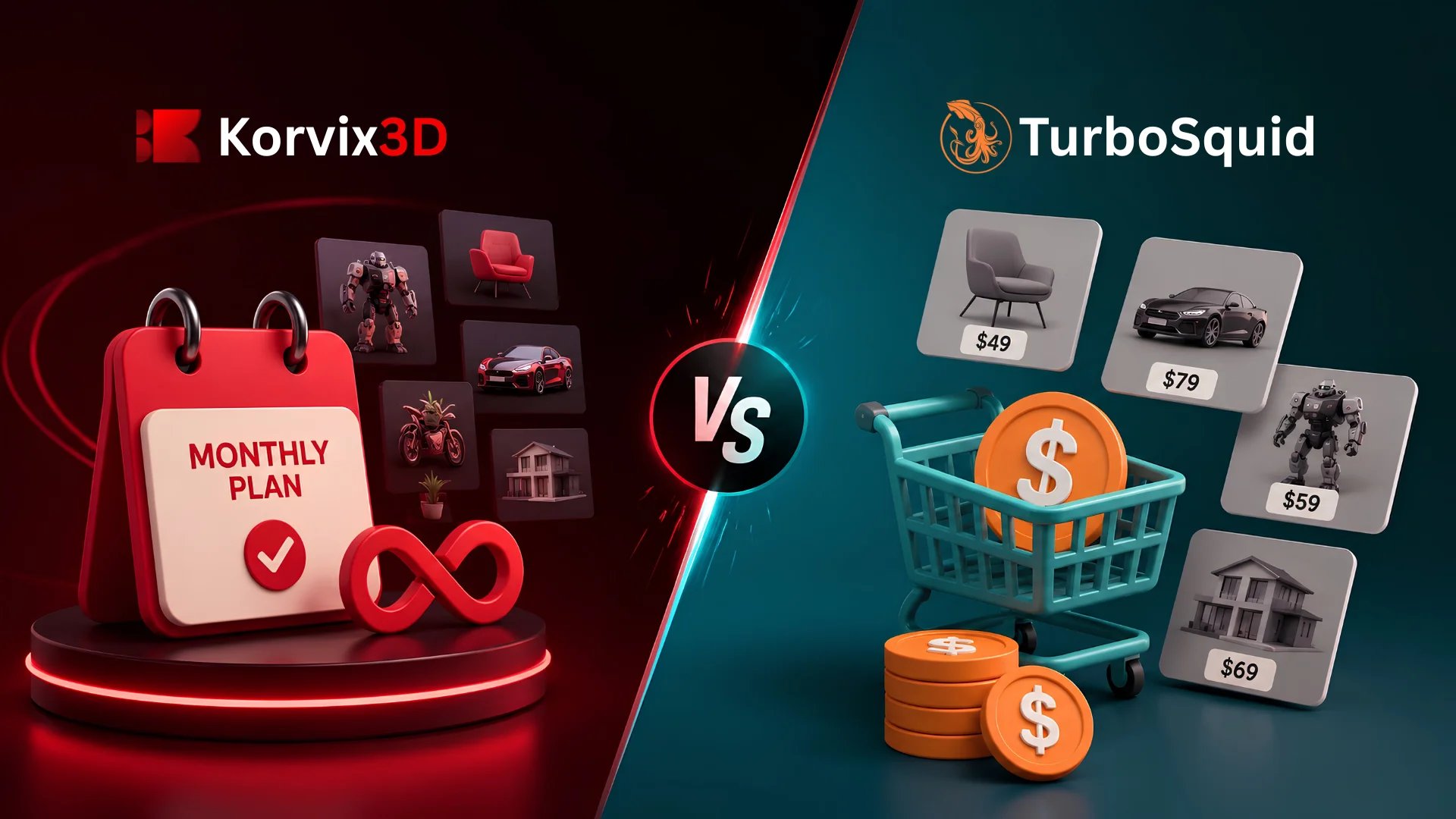
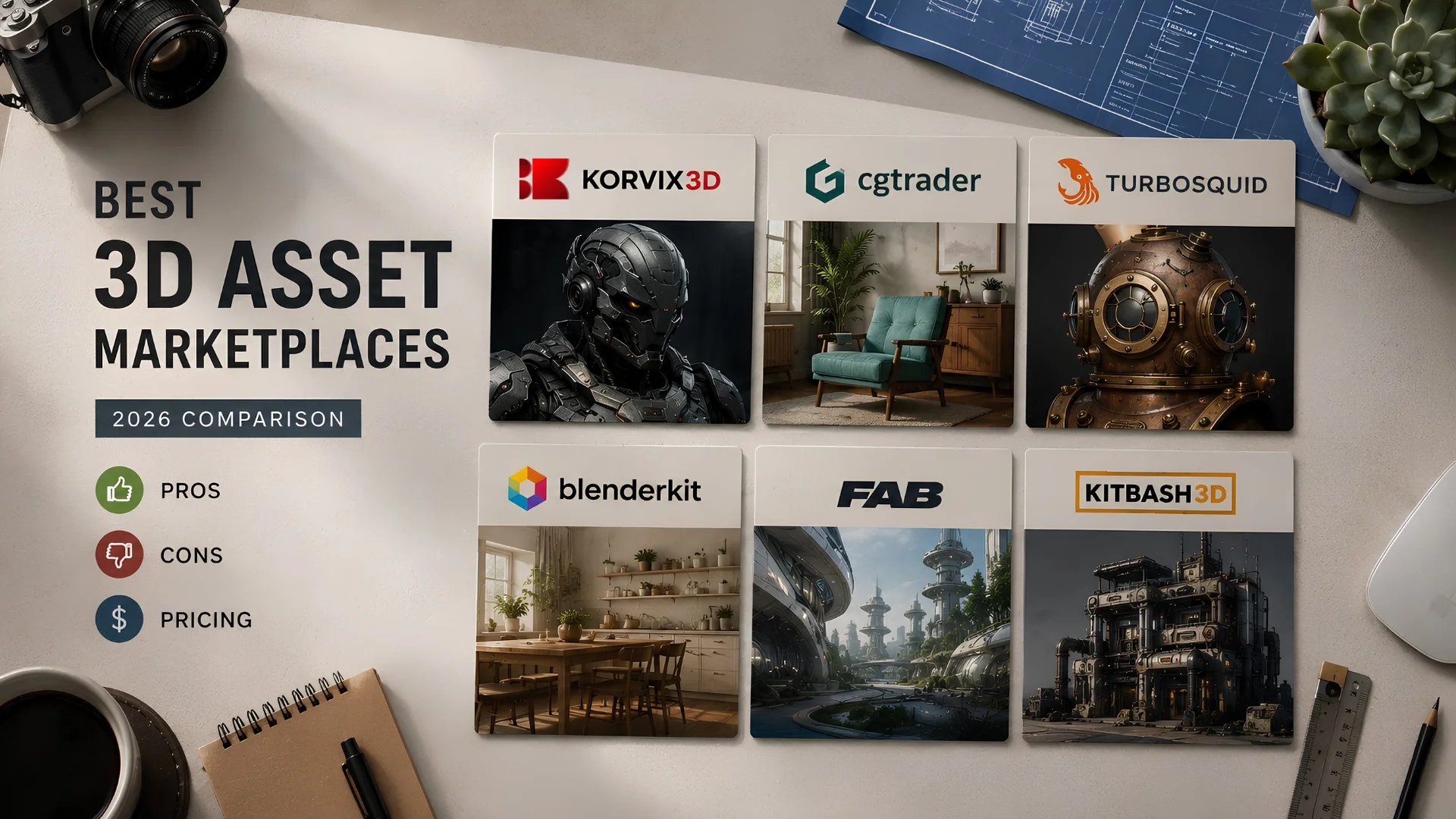
This comparison is not about whether TurboSquid has good assets. It does. It's about whether buying those assets individually at TurboSquid's price points makes sense for most working artists in 2026, or whether a monthly subscription model does the same job better and costs a fraction of the price. The answer, for most artists, is not subtle.
What TurboSquid Is and Who It Was Built For

TurboSquid built its reputation primarily serving a specific customer: the professional studio that needs one very specific, very high-quality asset for a defined production, is willing to pay a significant price for it, and doesn't need that kind of asset again for months. Think a VFX studio needing a specific aircraft model for a film sequence. A game publisher needing a certified, StemCell-compliant vehicle for a AAA title. An advertising agency needing a photorealistic branded product render.
For that use case, TurboSquid's model makes sense. You pay once, you get exactly what you need, the quality is certified through CheckMate review, and you move on.
The problem is that most working 3D artists don't work that way. They need assets regularly, across varied categories, for multiple projects running in parallel. The solo indie developer who needs thirty props for a game level, the archviz artist populating an interior with furniture and fixtures, the motion designer sourcing objects for a product launch video: none of these workflows look like the single-high-value-purchase scenario TurboSquid was built around. And when you use TurboSquid the way most artists actually need assets, the cost adds up to a number that doesn't make any economic sense.
The Price Comparison That Makes the Case

TurboSquid's pricing spans a wide range, from simple props under $20 to complex certified character rigs and vehicles that run $200, $400, even higher. The CheckMate-certified assets that represent TurboSquid's quality floor tend to sit in the middle to upper end of that range.
For a realistic comparison, let's use $50 as the average price for a quality TurboSquid asset that a professional would actually rely on in production. This is conservative: many of the assets experienced artists reach for on TurboSquid cost more than this.
Buying on TurboSquid at $50 average per asset:
5 assets per month: $250 per month, $3,000 per year 10 assets per month: $500 per month, $6,000 per year 20 assets per month: $1,000 per month, $12,000 per year
Subscribing to Korvix3D:
Pro plan: $12 per month (90 assets/month), or $129 per year on annual billing.
Plus plan: $25 per month (200 assets/month), or $240 per year on annual billing.
At 5 assets per month, TurboSquid costs $3,000 per year. Korvix3D Pro costs $129 per year. The saving is $2,871 annually, and that's at the lowest usage level in this comparison.
At 10 assets per month, TurboSquid costs $6,000 per year. Korvix3D Pro covers that volume entirely and costs $129. The saving is $5,871 per year.
At 20 assets per month, TurboSquid costs $12,000 per year. Korvix3D Pro still covers that comfortably within 90 assets per month and costs $129. The saving is $11,871 per year.
Even at TurboSquid's lowest realistic price point for professional assets, $20 per model, and at modest usage of 10 assets per month, the annual spend comes to $2,400. That's still $2,271 more than Korvix3D Pro's annual cost.
These numbers aren't manipulated to make the subscription look good. They're the straightforward result of how per-asset pricing interacts with regular professional usage. The more consistently you source assets, the more dramatically the subscription economics win.
The CheckMate Question: Does Quality Certification Matter Enough

to Pay the Premium?
TurboSquid's CheckMate program is the platform's most defensible advantage and worth addressing honestly. CheckMate Bronze and CheckMate Pro are quality certification tiers where assets are reviewed against specific technical standards including clean topology, proper UV mapping, real-world scale, and correct rendering behavior across major renderers. A CheckMate Pro asset has been verified to a level that the thumbnail alone cannot communicate.
For studios buying individual hero assets for specific high-stakes productions, this certification has real value. It reduces the evaluation burden before purchase and provides a level of technical assurance that self-reported "production ready" labels on open-submission platforms don't.
The question is whether that certification premium is worth $40 or $80 or $150 per asset when your alternative is a platform whose quality incentive structure produces consistently good assets through a different mechanism.
Korvix3D's quality system is structural rather than badge-based. Creator earnings are weighted by an Effort Rating Factor built from admin quality ratings at 60% weight and user reviews at 40%. An asset that earns poor quality evaluations generates less income per download than one that earns high evaluations. This creates an ongoing financial incentive for quality rather than a one-time certification gate.
The difference is that CheckMate is a stamp applied at upload and doesn't change. Korvix3D's rating system is dynamic: user reviews accumulate, admin ratings reflect ongoing platform standards, and creators who maintain quality stay prominent while those who don't see their assets drift lower in visibility and earnings. The system is self-correcting in ways that a one-time certification cannot be.
For the narrow use case of very high-stakes, one-off hero asset purchases where you want the maximum possible technical assurance before buying a $300 vehicle model, TurboSquid's CheckMate certification is genuinely useful. For the broad use case of sourcing assets regularly for a working production pipeline, Korvix3D's quality floor is consistently strong enough that the certification premium isn't worth the cost multiple.
Workflow: The Part of the Comparison TurboSquid Would Prefer

You Not Think About
TurboSquid has no software integration of any kind. No Blender plugin. No Maya panel. No 3DS Max connection. No Unity or Unreal Engine bridge. Every asset you source from TurboSquid is a browser purchase, a download, a file extraction, an import dialog, and then whatever time it takes to deal with the material and scale issues that come with any manual FBX or OBJ import.
For a single asset purchased once every few months, this process is a minor inconvenience. For a working artist sourcing assets regularly across multiple projects, it is a recurring time tax on every single asset in every single scene.
The time cost is not nothing. An import that takes fifteen minutes to clean up on a scene with twenty assets is five hours of non-creative work. Multiply that across a year of regular production and the time lost to manual import workflows is substantial.
Korvix3D's bridge plugins for Blender, Maya, 3DS Max, Cinema4D, Sketchup, Unity, and Unreal Engine replace that entire process. The plugin panel sits inside your application. You browse, you click, the asset arrives in your scene with materials configured for your renderer, correct scale, textures intact. The workflow difference between one-click import and the manual TurboSquid process is felt immediately on the first use and compounds across every asset for the life of your subscription.
For game developers specifically, TurboSquid's lack of engine integration is a more significant gap than it might appear on paper. Assets purchased on TurboSquid for use in Unity or Unreal Engine require download, format conversion, engine import, and manual material setup inside the engine's material system. Korvix3D's Unity and Unreal Engine plugins handle all of this automatically. For a developer who needs to rapidly populate a game world with assets, that difference translates directly into production speed.
Creator Economics: TurboSquid vs Korvix3D
TurboSquid's creator payout structure has improved over the years. The SquidGuild program provides tiered payout rates: exclusive assets earn higher percentages, while non-exclusive assets earn lower rates. The rates range from roughly 40% for non-exclusive non-member assets up to around 80% for exclusive SquidGuild members at the highest tier.
The exclusivity requirement for the highest earnings is a meaningful trade-off. A creator earning 80% on TurboSquid cannot list that same asset on Korvix3D or any other platform. They are locked into TurboSquid's buyer pool and pricing structure in exchange for the higher percentage.
For creators producing high-value, specialized assets that command $100 or more per purchase, TurboSquid's economics can be favorable. A $200 vehicle model with a 70% payout earns $140 from a single transaction.
But the transactional nature of per-asset earnings is also TurboSquid's creator economics limitation. An asset earns when it sells. When it stops selling, it stops earning. The income is not recurring, not compounding, and not tied to platform growth in any way that benefits the individual creator.
Korvix3D's creator pool distributes 70% of subscription revenue monthly across all creators, weighted by download performance and the Effort Rating Factor quality score. The income is genuinely recurring: assets that continue to be downloaded continue to generate income monthly, regardless of whether the creator is actively producing new work. As the platform's subscriber base grows, the total pool grows, and all creators benefit proportionally.
The Verified Badge system gives creators at Korvix3D a path to earnings multipliers unavailable anywhere on TurboSquid. Gold badge holders earn approximately 1.25times more per download than standard creators. Diamond badge holders earn approximately 1.5 times more. A creator with a Diamond badge and a well-downloaded library earns substantially more per download than the base pool rate, and earns it every month without new sales needing to happen.
For creators building long-term passive income from 3D assets rather than selling individual high-value pieces occasionally, Korvix3D's structure is meaningfully better.
There are genuine situations where TurboSquid serves professional needs better than any subscription platform.
Very high-value, one-off asset purchases where CheckMate certification provides assurance that's worth the price. A studio buying a $400 anatomically accurate medical visualization model for a pharmaceutical client presentation has different requirements than a solo developer populating a game world with props. For the former, CheckMate's technical verification is worth paying for.
Assets in categories where TurboSquid's library depth is unmatched. Two decades of uploads have produced coverage in some specialized categories that newer platforms simply don't have yet.
Situations where the specific asset doesn't exist on subscription platforms and the purchase is genuinely rare. Buying one asset every few months when you need something specific costs less than a monthly subscription for that usage pattern.
Outside these cases, the subscription model is faster, cheaper, and produces less workflow friction on every single asset sourced.
The Honest Summary
TurboSquid built a reputation on being the professional choice for individual asset purchases, and that reputation is partially deserved. The CheckMate certification is real. The library depth is real. The platform has been serving professional productions for over twenty years.
What TurboSquid has not built is a workflow for the way most working 3D artists actually source assets in 2026: regularly, across multiple projects, across multiple software environments, at a volume where per- asset pricing becomes economically painful before the end of the first month.
Korvix3D is built for that workflow. The subscription economics are dramatically more favorable at any meaningful usage volume. The bridge plugin system removes the import overhead that accumulates invisibly on every manually sourced asset. The quality-weighted creator economics produce a library that improves in quality over time rather than remaining static after certification.
For occasional, high-stakes, single-asset purchases, TurboSquid is worth knowing about. For everything else, the monthly plan wins without contest.
See Korvix3D plans → https://korvix3d.com/pricing
Explore plugins for your software → https://korvix3d.com/download#blender
Frequently Asked Questions
Is Korvix3D a good TurboSquid alternative? Yes, particularly for artists who source assets regularly rather than occasionally. At $12 per month for 90 assets on the Pro plan, or $25 per month for 200 assets on the Plus plan, Korvix3D costs a fraction of what the equivalent volume of TurboSquid purchases would cost. The addition of native bridge plugins for Blender, Maya, 3DS Max, Cinema4D, Sketchup, Unity, and Unreal Engine makes the workflow faster at every step compared to TurboSquid's browser-and-download process.
What is TurboSquid CheckMate and does Korvix3D have an equivalent? CheckMate is TurboSquid's quality certification program that reviews assets against specific technical standards before awarding a certification badge. Korvix3D uses a different approach: an ongoing effort-weighted quality rating built from admin evaluations and user reviews that influences creator earnings dynamically. Rather than a one-time certification gate, Korvix3D's system continuously incentivizes quality across the library because creators earn more per download when their assets maintain high quality ratings.
Does TurboSquid have any software integration or plugins? No. TurboSquid has no native integration with any 3D software or game engine. Every asset purchased on TurboSquid requires manual download, extraction, and import into your application. Korvix3D's bridge plugins for Blender, Maya, 3DS Max, Cinema4D, Sketchup, Unity, and Unreal Engine deliver assets directly into your active scene from inside your software.
How much does the average TurboSquid asset cost? Prices vary widely across the TurboSquid library, from under $20 for simple props to several hundred dollars for complex certified character rigs, vehicles, and architectural models. Quality assets from experienced creators that professional studios would actually rely on for production typically fall in the $30 to $200 range.
Can I use Korvix3D assets in commercial productions? Yes. Korvix3D's subscription license covers commercial use including game development, film and VFX, architectural visualization, advertising, and product visualization. The Pro plan at $12 per month or $129 per year, and the Plus plan at $25 per month or $240 per year, both include commercial licensing for all assets accessed during the subscription period.
Why does TurboSquid cost so much more than a subscription platform? TurboSquid's pricing reflects a per-transaction model where each asset is independently priced based on its complexity and the creator's valuation. There is no shared pool or volume benefit. Each purchase is a standalone transaction at a price the creator set, often reflecting significant time investment in high-quality, specialized work. This model makes sense for occasional large purchases but becomes expensive fast when sourcing assets at the volume that regular production requires.

TurboSquid has been around since 2000, which makes it one of the oldest names in 3D asset licensing. It has the brand recognition that comes with two decades of being the platform studios call when they need a specific model and need it fast. Its CheckMate certification program is genuinely respected in the industry. The library is large and contains some exceptional professional work.
It is also one of the most expensive ways a working 3D artist can source assets regularly, and it has no workflow integration with any 3D software on the planet.
This comparison is not about whether TurboSquid has good assets. It does. It's about whether buying those assets individually at TurboSquid's price points makes sense for most working artists in 2026, or whether a monthly subscription model does the same job better and costs a fraction of the price. The answer, for most artists, is not subtle.
What TurboSquid Is and Who It Was Built For
TurboSquid built its reputation primarily serving a specific customer: the professional studio that needs one very specific, very high-quality asset for a defined production, is willing to pay a significant price for it, and doesn't need that kind of asset again for months. Think a VFX studio needing a specific aircraft model for a film sequence. A game publisher needing a certified, StemCell-compliant vehicle for a AAA title. An advertising agency needing a photorealistic branded product render.
For that use case, TurboSquid's model makes sense. You pay once, you get exactly what you need, the quality is certified through CheckMate review, and you move on.
The problem is that most working 3D artists don't work that way. They need assets regularly, across varied categories, for multiple projects running in parallel. The solo indie developer who needs thirty props for a game level, the archviz artist populating an interior with furniture and fixtures, the motion designer sourcing objects for a product launch video: none of these workflows look like the single-high-value-purchase scenario TurboSquid was built around. And when you use TurboSquid the way most artists actually need assets, the cost adds up to a number that doesn't make any economic sense.
The Price Comparison That Makes the Case
TurboSquid's pricing spans a wide range, from simple props under $20 to complex certified character rigs and vehicles that run $200, $400, even higher. The CheckMate-certified assets that represent TurboSquid's quality floor tend to sit in the middle to upper end of that range.
For a realistic comparison, let's use $50 as the average price for a quality TurboSquid asset that a professional would actually rely on in production. This is conservative: many of the assets experienced artists reach for on TurboSquid cost more than this.
Buying on TurboSquid at $50 average per asset:
5 assets per month: $250 per month, $3,000 per year 10 assets per month: $500 per month, $6,000 per year 20 assets per month: $1,000 per month, $12,000 per year
Subscribing to Korvix3D:
Pro plan: $12 per month (90 assets/month), or $129 per year on annual billing.
Plus plan: $25 per month (200 assets/month), or $240 per year on annual billing.
At 5 assets per month, TurboSquid costs $3,000 per year. Korvix3D Pro costs $129 per year. The saving is $2,871 annually, and that's at the lowest usage level in this comparison.
At 10 assets per month, TurboSquid costs $6,000 per year. Korvix3D Pro covers that volume entirely and costs $129. The saving is $5,871 per year.
At 20 assets per month, TurboSquid costs $12,000 per year. Korvix3D Pro still covers that comfortably within 90 assets per month and costs $129. The saving is $11,871 per year.
Even at TurboSquid's lowest realistic price point for professional assets, $20 per model, and at modest usage of 10 assets per month, the annual spend comes to $2,400. That's still $2,271 more than Korvix3D Pro's annual cost.
These numbers aren't manipulated to make the subscription look good. They're the straightforward result of how per-asset pricing interacts with regular professional usage. The more consistently you source assets, the more dramatically the subscription economics win.
The CheckMate Question: Does Quality Certification Matter Enough
to Pay the Premium?
TurboSquid's CheckMate program is the platform's most defensible advantage and worth addressing honestly. CheckMate Bronze and CheckMate Pro are quality certification tiers where assets are reviewed against specific technical standards including clean topology, proper UV mapping, real-world scale, and correct rendering behavior across major renderers. A CheckMate Pro asset has been verified to a level that the thumbnail alone cannot communicate.
For studios buying individual hero assets for specific high-stakes productions, this certification has real value. It reduces the evaluation burden before purchase and provides a level of technical assurance that self-reported "production ready" labels on open-submission platforms don't.
The question is whether that certification premium is worth $40 or $80 or $150 per asset when your alternative is a platform whose quality incentive structure produces consistently good assets through a different mechanism.
Korvix3D's quality system is structural rather than badge-based. Creator earnings are weighted by an Effort Rating Factor built from admin quality ratings at 60% weight and user reviews at 40%. An asset that earns poor quality evaluations generates less income per download than one that earns high evaluations. This creates an ongoing financial incentive for quality rather than a one-time certification gate.
The difference is that CheckMate is a stamp applied at upload and doesn't change. Korvix3D's rating system is dynamic: user reviews accumulate, admin ratings reflect ongoing platform standards, and creators who maintain quality stay prominent while those who don't see their assets drift lower in visibility and earnings. The system is self-correcting in ways that a one-time certification cannot be.
For the narrow use case of very high-stakes, one-off hero asset purchases where you want the maximum possible technical assurance before buying a $300 vehicle model, TurboSquid's CheckMate certification is genuinely useful. For the broad use case of sourcing assets regularly for a working production pipeline, Korvix3D's quality floor is consistently strong enough that the certification premium isn't worth the cost multiple.
Workflow: The Part of the Comparison TurboSquid Would Prefer
You Not Think About
TurboSquid has no software integration of any kind. No Blender plugin. No Maya panel. No 3DS Max connection. No Unity or Unreal Engine bridge. Every asset you source from TurboSquid is a browser purchase, a download, a file extraction, an import dialog, and then whatever time it takes to deal with the material and scale issues that come with any manual FBX or OBJ import.
For a single asset purchased once every few months, this process is a minor inconvenience. For a working artist sourcing assets regularly across multiple projects, it is a recurring time tax on every single asset in every single scene.
The time cost is not nothing. An import that takes fifteen minutes to clean up on a scene with twenty assets is five hours of non-creative work. Multiply that across a year of regular production and the time lost to manual import workflows is substantial.
Korvix3D's bridge plugins for Blender, Maya, 3DS Max, Cinema4D, Sketchup, Unity, and Unreal Engine replace that entire process. The plugin panel sits inside your application. You browse, you click, the asset arrives in your scene with materials configured for your renderer, correct scale, textures intact. The workflow difference between one-click import and the manual TurboSquid process is felt immediately on the first use and compounds across every asset for the life of your subscription.
For game developers specifically, TurboSquid's lack of engine integration is a more significant gap than it might appear on paper. Assets purchased on TurboSquid for use in Unity or Unreal Engine require download, format conversion, engine import, and manual material setup inside the engine's material system. Korvix3D's Unity and Unreal Engine plugins handle all of this automatically. For a developer who needs to rapidly populate a game world with assets, that difference translates directly into production speed.
Creator Economics: TurboSquid vs Korvix3D
TurboSquid's creator payout structure has improved over the years. The SquidGuild program provides tiered payout rates: exclusive assets earn higher percentages, while non-exclusive assets earn lower rates. The rates range from roughly 40% for non-exclusive non-member assets up to around 80% for exclusive SquidGuild members at the highest tier.
The exclusivity requirement for the highest earnings is a meaningful trade-off. A creator earning 80% on TurboSquid cannot list that same asset on Korvix3D or any other platform. They are locked into TurboSquid's buyer pool and pricing structure in exchange for the higher percentage.
For creators producing high-value, specialized assets that command $100 or more per purchase, TurboSquid's economics can be favorable. A $200 vehicle model with a 70% payout earns $140 from a single transaction.
But the transactional nature of per-asset earnings is also TurboSquid's creator economics limitation. An asset earns when it sells. When it stops selling, it stops earning. The income is not recurring, not compounding, and not tied to platform growth in any way that benefits the individual creator.
Korvix3D's creator pool distributes 70% of subscription revenue monthly across all creators, weighted by download performance and the Effort Rating Factor quality score. The income is genuinely recurring: assets that continue to be downloaded continue to generate income monthly, regardless of whether the creator is actively producing new work. As the platform's subscriber base grows, the total pool grows, and all creators benefit proportionally.
The Verified Badge system gives creators at Korvix3D a path to earnings multipliers unavailable anywhere on TurboSquid. Gold badge holders earn approximately 1.25times more per download than standard creators. Diamond badge holders earn approximately 1.5 times more. A creator with a Diamond badge and a well-downloaded library earns substantially more per download than the base pool rate, and earns it every month without new sales needing to happen.
For creators building long-term passive income from 3D assets rather than selling individual high-value pieces occasionally, Korvix3D's structure is meaningfully better.
When TurboSquid Is Still the Right Tool
There are genuine situations where TurboSquid serves professional needs better than any subscription platform.
Very high-value, one-off asset purchases where CheckMate certification provides assurance that's worth the price. A studio buying a $400 anatomically accurate medical visualization model for a pharmaceutical client presentation has different requirements than a solo developer populating a game world with props. For the former, CheckMate's technical verification is worth paying for.
Assets in categories where TurboSquid's library depth is unmatched. Two decades of uploads have produced coverage in some specialized categories that newer platforms simply don't have yet.
Situations where the specific asset doesn't exist on subscription platforms and the purchase is genuinely rare. Buying one asset every few months when you need something specific costs less than a monthly subscription for that usage pattern.
Outside these cases, the subscription model is faster, cheaper, and produces less workflow friction on every single asset sourced.
The Honest Summary
TurboSquid built a reputation on being the professional choice for individual asset purchases, and that reputation is partially deserved. The CheckMate certification is real. The library depth is real. The platform has been serving professional productions for over twenty years.
What TurboSquid has not built is a workflow for the way most working 3D artists actually source assets in 2026: regularly, across multiple projects, across multiple software environments, at a volume where per- asset pricing becomes economically painful before the end of the first month.
Korvix3D is built for that workflow. The subscription economics are dramatically more favorable at any meaningful usage volume. The bridge plugin system removes the import overhead that accumulates invisibly on every manually sourced asset. The quality-weighted creator economics produce a library that improves in quality over time rather than remaining static after certification.
For occasional, high-stakes, single-asset purchases, TurboSquid is worth knowing about. For everything else, the monthly plan wins without contest.
See Korvix3D plans → https://korvix3d.com/pricing
Explore plugins for your software → https://korvix3d.com/download#blender
Frequently Asked Questions
Is Korvix3D a good TurboSquid alternative? Yes, particularly for artists who source assets regularly rather than occasionally. At $12 per month for 90 assets on the Pro plan, or $25 per month for 200 assets on the Plus plan, Korvix3D costs a fraction of what the equivalent volume of TurboSquid purchases would cost. The addition of native bridge plugins for Blender, Maya, 3DS Max, Cinema4D, Sketchup, Unity, and Unreal Engine makes the workflow faster at every step compared to TurboSquid's browser-and-download process.
What is TurboSquid CheckMate and does Korvix3D have an equivalent? CheckMate is TurboSquid's quality certification program that reviews assets against specific technical standards before awarding a certification badge. Korvix3D uses a different approach: an ongoing effort-weighted quality rating built from admin evaluations and user reviews that influences creator earnings dynamically. Rather than a one-time certification gate, Korvix3D's system continuously incentivizes quality across the library because creators earn more per download when their assets maintain high quality ratings.
Does TurboSquid have any software integration or plugins? No. TurboSquid has no native integration with any 3D software or game engine. Every asset purchased on TurboSquid requires manual download, extraction, and import into your application. Korvix3D's bridge plugins for Blender, Maya, 3DS Max, Cinema4D, Sketchup, Unity, and Unreal Engine deliver assets directly into your active scene from inside your software.
How much does the average TurboSquid asset cost? Prices vary widely across the TurboSquid library, from under $20 for simple props to several hundred dollars for complex certified character rigs, vehicles, and architectural models. Quality assets from experienced creators that professional studios would actually rely on for production typically fall in the $30 to $200 range.
Can I use Korvix3D assets in commercial productions? Yes. Korvix3D's subscription license covers commercial use including game development, film and VFX, architectural visualization, advertising, and product visualization. The Pro plan at $12 per month or $129 per year, and the Plus plan at $25 per month or $240 per year, both include commercial licensing for all assets accessed during the subscription period.
Why does TurboSquid cost so much more than a subscription platform? TurboSquid's pricing reflects a per-transaction model where each asset is independently priced based on its complexity and the creator's valuation. There is no shared pool or volume benefit. Each purchase is a standalone transaction at a price the creator set, often reflecting significant time investment in high-quality, specialized work. This model makes sense for occasional large purchases but becomes expensive fast when sourcing assets at the volume that regular production requires.