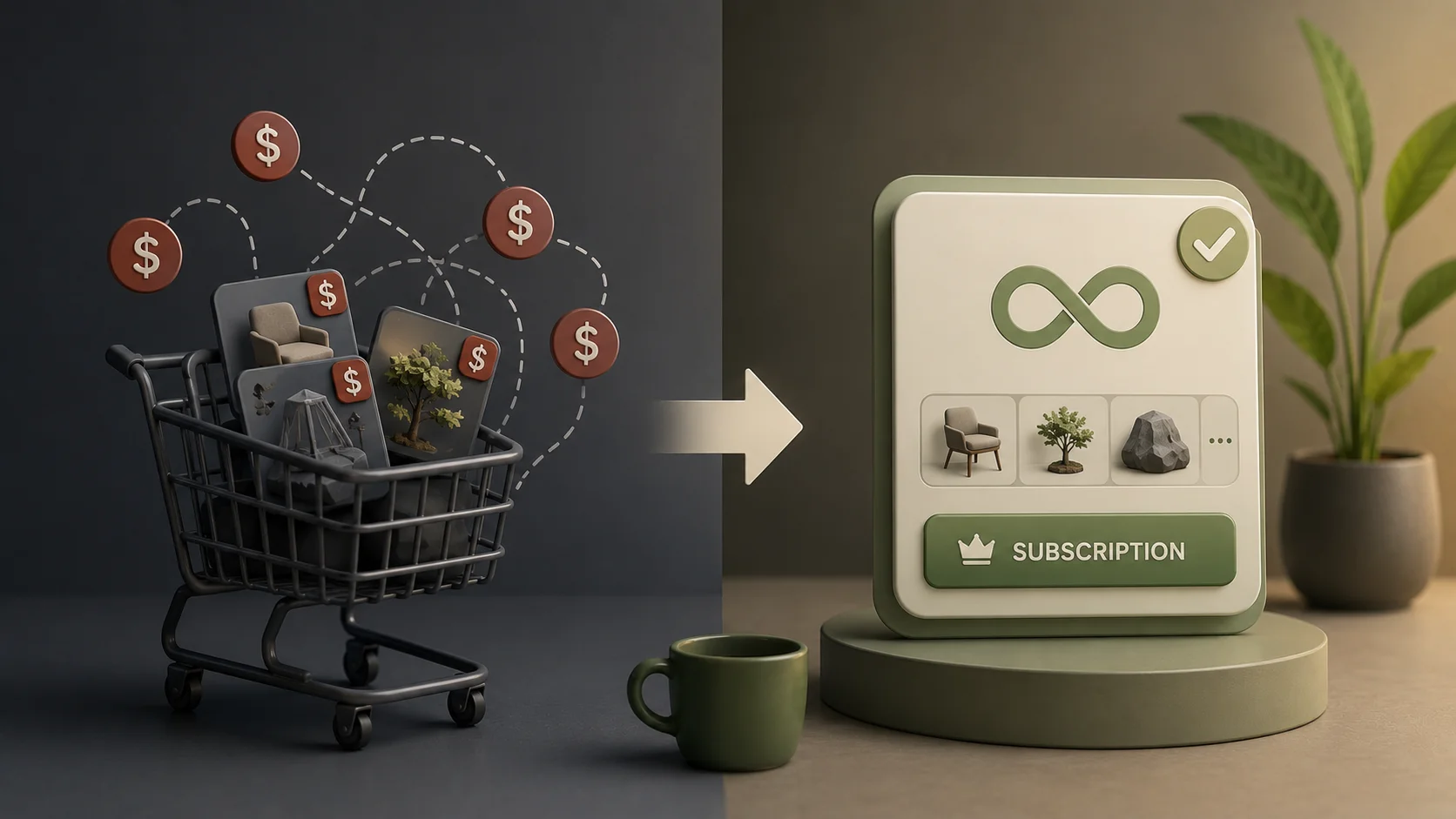
Per-asset pricing has an intuitive appeal that's hard to argue with on the surface. You need something, you pay for it, you have it. No ongoing cost, no commitment, no subscription you forget to cancel. The economics feel clean and honest in a way that monthly billing never quite does.
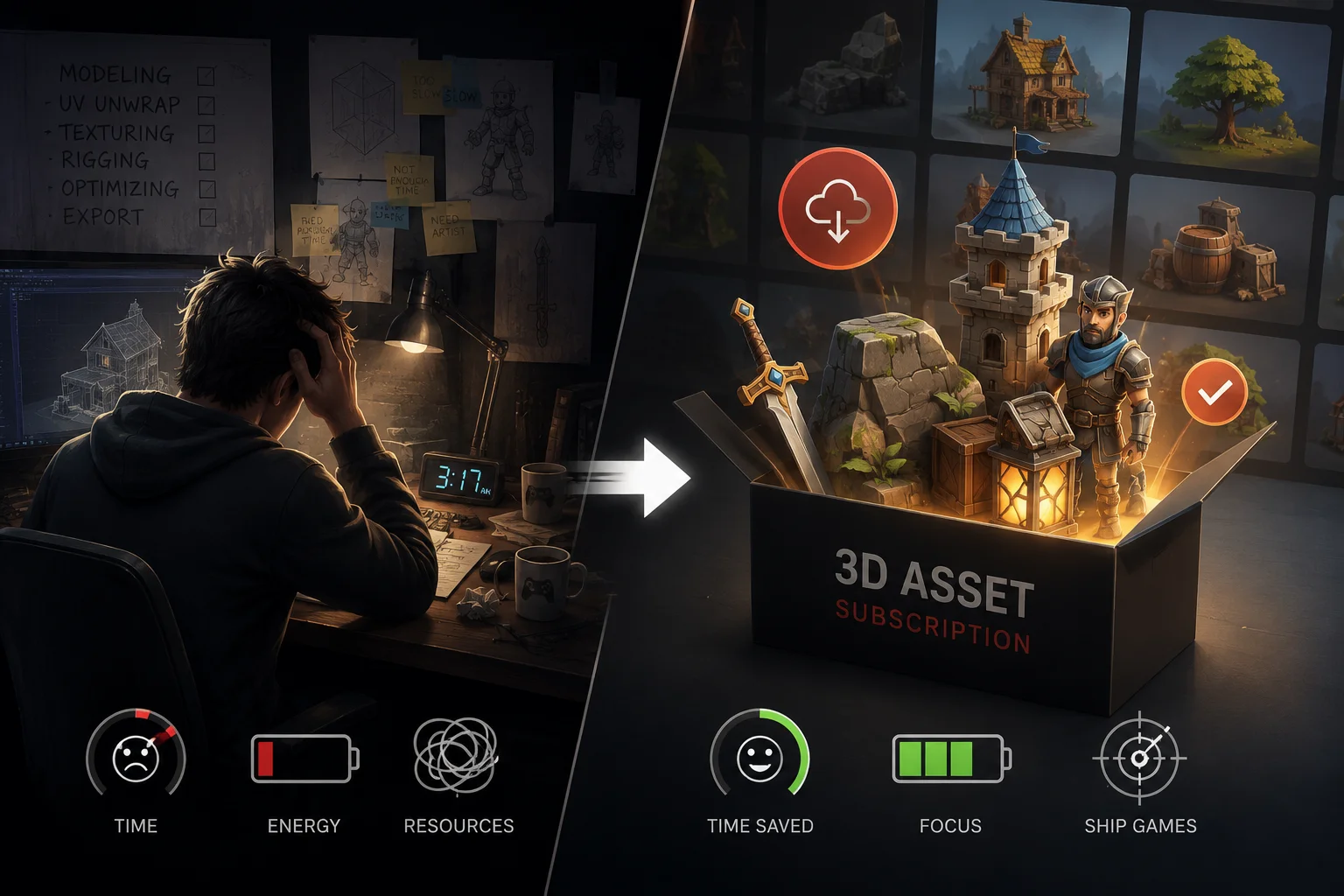
The problem is that per-asset pricing was designed around a buying behavior that doesn't match how creative professionals actually use 3D assets. It was built for occasional, deliberate purchases, the kind of buying that happens a few times a year when a project requires something specific. Most working artists, game developers, and visualization studios don't use assets that way. And when you use per-asset pricing the way professionals actually use 3D content, the model starts producing outcomes that are bad for your work, bad for your budget, and in ways that are less obvious, bad for the quality of assets the market produces.
This article is about those specific problems and what the subscription model actually fixes. Not in vague terms, but in the concrete ways that show up in your workflow every week.
Problem One: Every Purchase Is a Decision, and Decisions Are Expensive

There's a cognitive cost to making choices that most people underestimate because it's invisible. When you browse a per-asset marketplace with the intention of buying, you're not just looking. You're evaluating. Is this asset good enough? Is it worth $35? Is there a better one if I keep looking? Would I rather spend $20 on this or $40 on the better version? Should I wait and model this myself instead?
These are real mental calculations, and they happen with every potential purchase. On a project where you need twenty or thirty assets, that evaluation process happens twenty or thirty times, consuming a portion of the limited mental energy you have in a working day.
Behavioral economists call this decision fatigue, and it produces a specific and well-documented outcome: the decisions you make later in a sequence are worse than the decisions you make earlier. Not because you become careless, but because the brain, having spent energy on earlier decisions, looks for shortcuts on later ones. In a per-asset buying context, the shortcut is almost always to buy whatever is cheapest, or to give up browsing and use a mediocre asset rather than continuing to evaluate.
This is why many artists working under per-asset pricing report buying assets that were "fine but not great" rather than searching until they found the best option. The decision cost of extended browsing eventually outweighs the perceived benefit of finding something marginally better.
Subscriptions remove this problem at its root. When there's no cost at the point of use, the evaluation question shifts from "is this worth paying for" to "is this the best option for my scene." Those are fundamentally different questions and they produce different browsing behavior. Artists with subscription access consistently report exploring more options, trying assets they wouldn't have risked money on, and finding better solutions because they had the cognitive space to keep looking rather than being worn down by repeated purchase decisions.
Problem Two: Per-Asset Pricing Makes You Ration Your Own Work
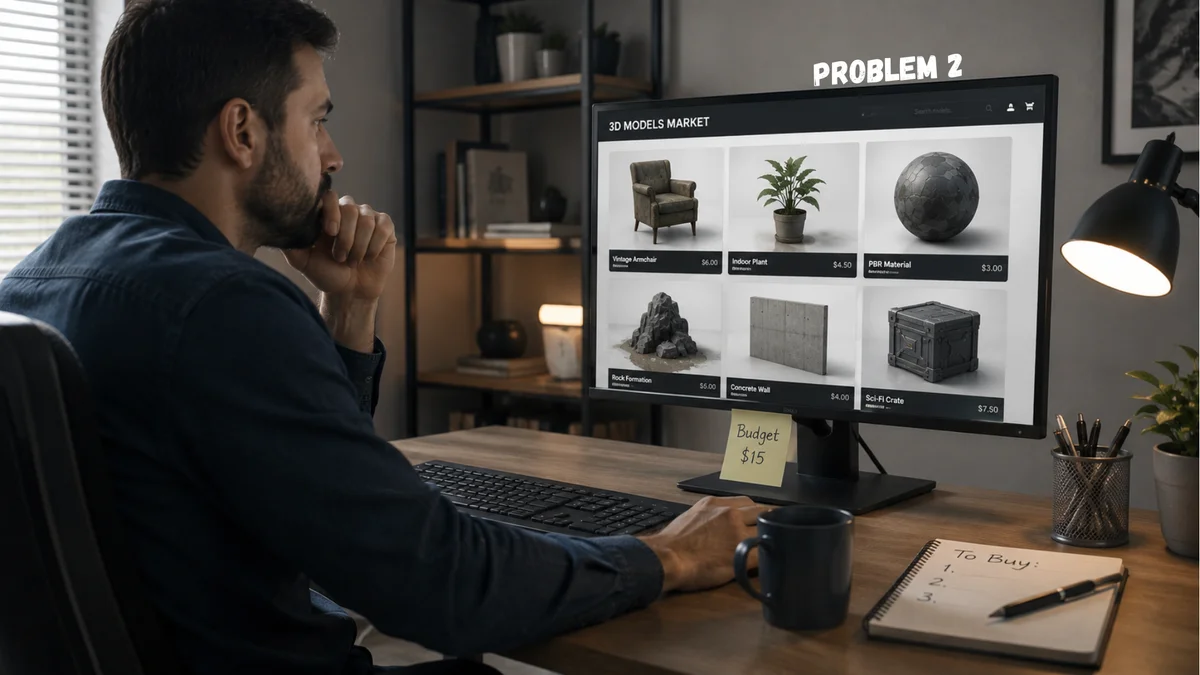
This is the per-asset problem that artists feel most acutely but rarely articulate clearly: when assets have individual prices attached, you start rationing how freely you use them.
Rationing shows up in a few specific behaviors. You use the same asset in multiple projects because you've already paid for it, even when a different asset would work better for a specific scene. You skip testing an asset in a prototype because buying it for a throwaway version feels wasteful, even though testing with real assets would tell you more about the final result. You avoid the higher-quality $60 version of an asset and buy the $20 version instead, not because the $20 version is good enough but because the gap doesn't feel justifiable at the point of purchase.
Every one of these behaviors is rational from a cost-management standpoint and counterproductive from a quality standpoint. You're making your work worse to save money on the assets, which is backwards if the quality of the work is what you're actually being paid for.
The subscription model doesn't eliminate the need to choose between assets, but it eliminates the financial weight behind those choices. When every asset in the library is available for the same monthly cost you've already committed to, using a different asset in a different project has no additional cost. Testing ten options before committing to one has no additional cost. Choosing the better asset over the cheaper one has no additional cost, because per-unit cost differences don't exist within a subscription.
Problem Three: The Economics Break at Volume
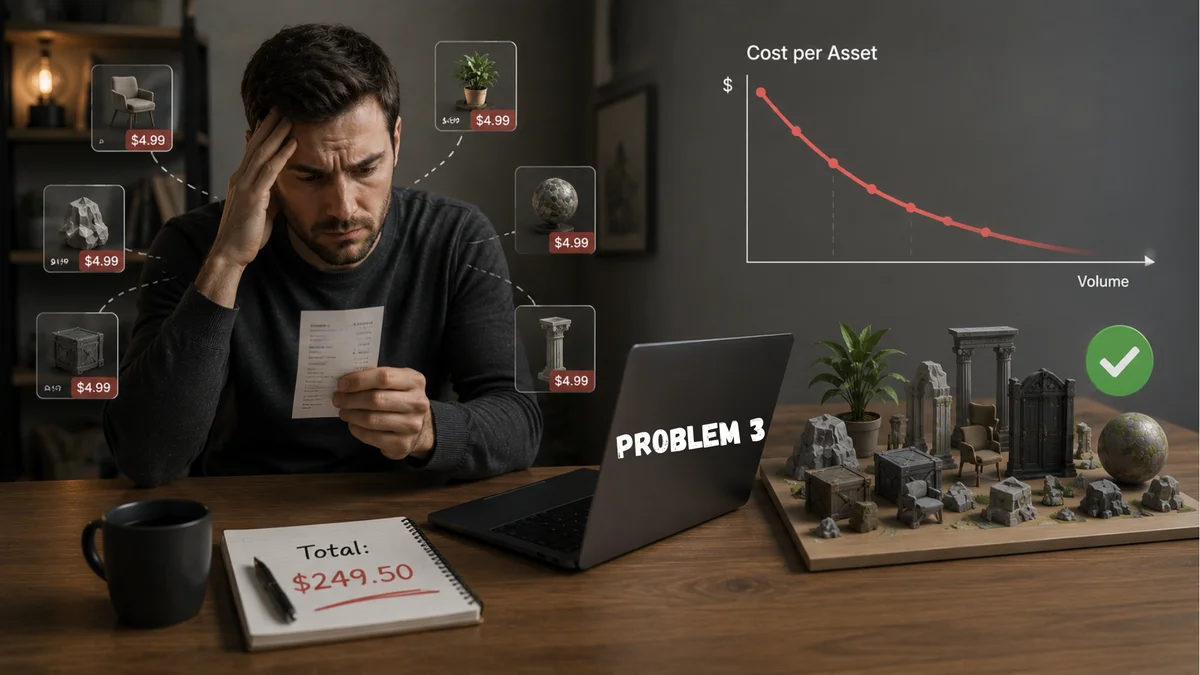
Per-asset pricing works out reasonably well if you're buying one or two assets a month. It becomes economically indefensible at the volumes that professional creative work actually requires.
The math isn't subtle. A working architectural visualization artist populating an interior scene might need thirty to fifty assets across a single project: furniture, lighting fixtures, decorative objects, plants, materials, textiles. At $25 to $50 per asset (a conservative estimate for quality assets on per-asset platforms), a single project's asset spend reaches $750 to $2,500, on top of the time cost of sourcing and importing each one.
A Korvix3D Pro subscription at $12 a month, or Plus at $25 a month, covers that entire project's asset needs for less than the cost of a single mid-range asset purchase on a per-unit marketplace. The same subscription also covers the next project, and the one after that, and the side project running in parallel, all for the same monthly fee.
The break-even point, where a subscription costs the same as per-asset purchasing for the same volume of assets, is somewhere around two to three assets per month for most price points. Below that, per-asset might cost less. Above it, subscription wins by a margin that grows with every additional asset.
Most professional 3D artists aren't anywhere near the break-even point. They're using assets at a volume where per-asset pricing is costing them anywhere from five to twenty times what a subscription would cost for the same access.
Problem Four: Per-Asset Pricing Distorts What Creators Build
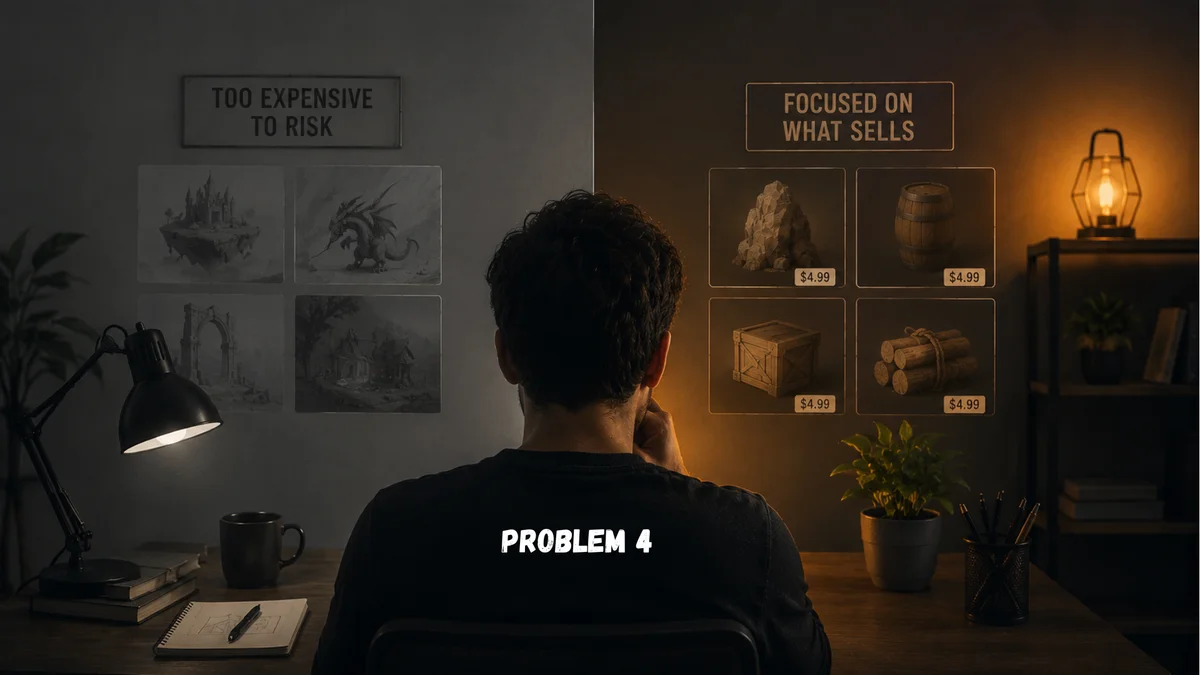
This one affects buyers indirectly, but it's worth understanding because it shapes the quality and type of assets available on per-asset platforms.
On a per-asset marketplace, creator income is tied directly to sales volume. The more an asset sells, the more the creator earns. This sounds like it should reward quality, and in some cases it does, but the incentive it actually creates is more complicated.
Per-asset sales volume is driven heavily by a few factors: thumbnail quality, title and tags, price competitiveness, and early sales velocity (platforms tend to surface assets that are already selling). The quality of the asset itself, the topology, UV mapping, texture accuracy, and production readiness, matters only insofar as it avoids bad reviews. A mediocre asset with a great thumbnail and competitive pricing can outsell an excellent asset with a mediocre thumbnail and higher price.
The practical result is that per-asset platforms incentivize marketing over craft. Creators who understand SEO, thumbnail production, and pricing strategy do well regardless of whether their assets are exceptional. Creators who focus on technical excellence without the marketing layer often underperform their actual quality level.
This doesn't mean per-asset marketplaces don't have excellent assets, they do. But the incentive structure doesn't actively filter for quality or reward the creators who invest the most effort in building to a high standard.
Subscription platforms with download-weighted creator economics create a different incentive. When creator earnings are tied to how often their assets are actually downloaded and used, the signal is closer to genuine value delivered. An asset that downloads well month after month is one that people find useful in their actual work, which is a better proxy for quality than one-time sales performance.
Korvix3D's effort-weighted payout system goes further by explicitly incorporating quality scores into creator earnings. Admin quality ratings at 60% weight and user reviews at 40% weight determine a quality multiplier applied to every download. A creator producing genuinely excellent assets earns more per download than one producing average work, even if both get similar download volumes. This directly rewards craft in a way that per-asset sales never can.
Problem Five: Switching Costs Lock You Into Bad Sources
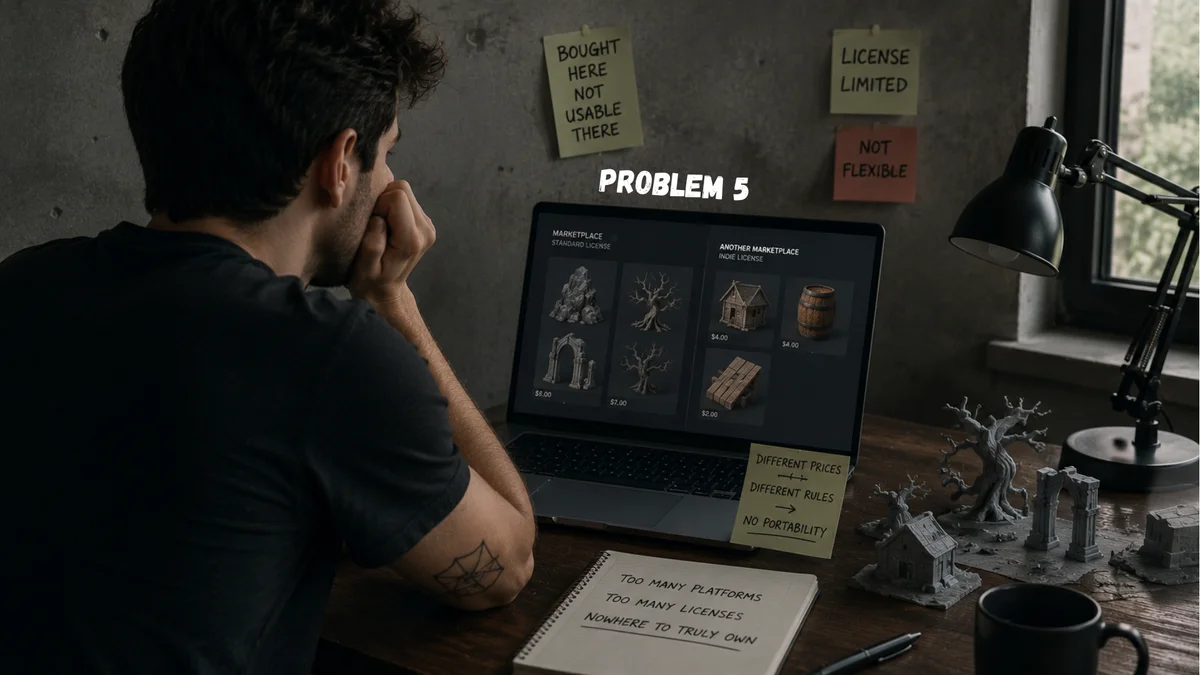
Per-asset purchasing creates a subtle lock-in effect that most buyers don't notice until they've been using a marketplace for a while.
When you've purchased fifty assets from a specific marketplace, you've implicitly committed to that marketplace. Not contractually, but behaviorally: you know their search system, you know what categories they're strong in, you've figured out which creators produce quality work. Switching to a different source means starting that learning process over, which has a real time cost.
This lock-in benefits the marketplace more than the buyer. It means buyers continue purchasing from sources they know even when better options exist elsewhere, because the switching cost makes complacency rational.
Subscriptions reduce this lock-in because the cost of trying a different platform is just the monthly fee, which you can cancel. There's no sunk cost of individual purchases on a platform you want to leave. If a subscription platform's library doesn't cover what you need, you cancel at the end of the month with no assets lost and no money wasted beyond that month's fee.
What Subscriptions Don't Fix
Honest coverage of this topic requires acknowledging that subscriptions don't solve every problem with 3D asset economics, and there are specific situations where per-asset purchasing is genuinely the better choice.
If you need a very specific, high-complexity asset that isn't available in any subscription library, per-asset purchasing from a specialist source is the right call. Subscription libraries are broad but not comprehensive, and the niche or highly specialized asset that defines a specific project might only exist as a standalone marketplace purchase.
If you use assets genuinely rarely, once or twice every few months, the economics of per-asset purchasing might cost less than a subscription even at modest per-unit prices. The break-even math only favors subscriptions above a certain usage volume.
And if a specific project requires assets under a license that extends beyond standard commercial use, per-asset purchases sometimes offer license terms that subscription platforms don't provide, particularly for assets used in products with unusual distribution arrangements.
The honest picture is a hybrid: a subscription as the primary source for the broad volume of everyday asset needs, and targeted per-asset purchases for the specific, unusual, or high-complexity assets that fall outside what the subscription library covers.
The Real Argument for Subscriptions Isn't About Price
Everything above makes the economic case for subscriptions, and the economics are genuinely compelling. But the strongest argument for subscriptions isn't that they cost less.
It's that removing the per-asset cost decision from the workflow changes how creative professionals actually work. It removes a source of cognitive friction from the most repetitive part of the sourcing process. It removes the financial pressure that causes artists to settle for "good enough" when "better" is available. It removes the rationing behavior that makes professionals use their assets less freely than they should.
The outcome isn't just cheaper asset access. It's a slightly different way of working, one where the asset library is genuinely available as a creative resource rather than a budget line to be managed carefully. Whether that change in working style produces better output is ultimately something each artist experiences for themselves, but the artists who've made the switch almost universally describe the change as better rather than just cheaper.
See Korvix3D subscription plans → https://korvix3d.com/pricing
Start with the free plan → https://korvix3d.com/signup
Frequently Asked Questions
Is per-asset pricing ever better than a subscription for 3D assets? Yes, in specific situations. Very infrequent buyers, once or twice per quarter, often spend less per-asset than a monthly subscription would cost. Highly specialized or niche assets not covered by subscription libraries still require per-asset purchasing. And projects requiring unusual license terms occasionally need per-asset arrangements that subscriptions don't provide. For most professional artists with regular asset needs, subscriptions cost less and work better, but they're not universally superior in every scenario.
What happens to assets I've downloaded if I cancel a subscription? This depends entirely on the platform's license terms, and it's one of the most important things to check before subscribing to any platform. Some platforms grant a perpetual license for assets downloaded during an active subscription period, allowing continued use after cancellation. Others require an active subscription to maintain the commercial license. At Korvix3D, license terms are written in plain language without the ambiguity that makes this question hard to answer on some other platforms.
How does subscription pricing compare to buying an asset pack? An asset pack is a one-time purchase of a fixed collection in a specific category. A subscription gives ongoing access to a continuously growing library across all categories. Packs make sense when you need a large volume of a specific type of asset and are confident the pack covers everything you need for a defined project. Subscriptions are better for ongoing, varied asset needs across multiple projects because the library grows continuously and the cost doesn't multiply with usage.
Do subscription platforms have lower quality assets than per-asset marketplaces? Not inherently, and platforms with quality-weighted creator economics arguably have higher average quality floors than open per-asset marketplaces, because the economic incentive structure rewards quality rather than marketing. The quality of any specific platform depends on its curation standards and creator economics, not on whether it uses a subscription or per-asset model.
Can I use assets from both per-asset and subscription platforms in the same project? Yes, assuming both licenses cover your intended commercial use, which is standard for most professional platforms. Using assets from multiple sources in the same project is common practice. The main thing to track is which license terms apply to which assets in the project, particularly if the project has any unusual distribution or commercial arrangements.



Per-asset pricing has an intuitive appeal that's hard to argue with on the surface. You need something, you pay for it, you have it. No ongoing cost, no commitment, no subscription you forget to cancel. The economics feel clean and honest in a way that monthly billing never quite does.
The problem is that per-asset pricing was designed around a buying behavior that doesn't match how creative professionals actually use 3D assets. It was built for occasional, deliberate purchases, the kind of buying that happens a few times a year when a project requires something specific. Most working artists, game developers, and visualization studios don't use assets that way. And when you use per-asset pricing the way professionals actually use 3D content, the model starts producing outcomes that are bad for your work, bad for your budget, and in ways that are less obvious, bad for the quality of assets the market produces.
This article is about those specific problems and what the subscription model actually fixes. Not in vague terms, but in the concrete ways that show up in your workflow every week.
Problem One: Every Purchase Is a Decision, and Decisions Are Expensive
There's a cognitive cost to making choices that most people underestimate because it's invisible. When you browse a per-asset marketplace with the intention of buying, you're not just looking. You're evaluating. Is this asset good enough? Is it worth $35? Is there a better one if I keep looking? Would I rather spend $20 on this or $40 on the better version? Should I wait and model this myself instead?
These are real mental calculations, and they happen with every potential purchase. On a project where you need twenty or thirty assets, that evaluation process happens twenty or thirty times, consuming a portion of the limited mental energy you have in a working day.
Behavioral economists call this decision fatigue, and it produces a specific and well-documented outcome: the decisions you make later in a sequence are worse than the decisions you make earlier. Not because you become careless, but because the brain, having spent energy on earlier decisions, looks for shortcuts on later ones. In a per-asset buying context, the shortcut is almost always to buy whatever is cheapest, or to give up browsing and use a mediocre asset rather than continuing to evaluate.
This is why many artists working under per-asset pricing report buying assets that were "fine but not great" rather than searching until they found the best option. The decision cost of extended browsing eventually outweighs the perceived benefit of finding something marginally better.
Subscriptions remove this problem at its root. When there's no cost at the point of use, the evaluation question shifts from "is this worth paying for" to "is this the best option for my scene." Those are fundamentally different questions and they produce different browsing behavior. Artists with subscription access consistently report exploring more options, trying assets they wouldn't have risked money on, and finding better solutions because they had the cognitive space to keep looking rather than being worn down by repeated purchase decisions.
Problem Two: Per-Asset Pricing Makes You Ration Your Own Work
This is the per-asset problem that artists feel most acutely but rarely articulate clearly: when assets have individual prices attached, you start rationing how freely you use them.
Rationing shows up in a few specific behaviors. You use the same asset in multiple projects because you've already paid for it, even when a different asset would work better for a specific scene. You skip testing an asset in a prototype because buying it for a throwaway version feels wasteful, even though testing with real assets would tell you more about the final result. You avoid the higher-quality $60 version of an asset and buy the $20 version instead, not because the $20 version is good enough but because the gap doesn't feel justifiable at the point of purchase.
Every one of these behaviors is rational from a cost-management standpoint and counterproductive from a quality standpoint. You're making your work worse to save money on the assets, which is backwards if the quality of the work is what you're actually being paid for.
The subscription model doesn't eliminate the need to choose between assets, but it eliminates the financial weight behind those choices. When every asset in the library is available for the same monthly cost you've already committed to, using a different asset in a different project has no additional cost. Testing ten options before committing to one has no additional cost. Choosing the better asset over the cheaper one has no additional cost, because per-unit cost differences don't exist within a subscription.
Problem Three: The Economics Break at Volume
Per-asset pricing works out reasonably well if you're buying one or two assets a month. It becomes economically indefensible at the volumes that professional creative work actually requires.
The math isn't subtle. A working architectural visualization artist populating an interior scene might need thirty to fifty assets across a single project: furniture, lighting fixtures, decorative objects, plants, materials, textiles. At $25 to $50 per asset (a conservative estimate for quality assets on per-asset platforms), a single project's asset spend reaches $750 to $2,500, on top of the time cost of sourcing and importing each one.
A Korvix3D Pro subscription at $12 a month, or Plus at $25 a month, covers that entire project's asset needs for less than the cost of a single mid-range asset purchase on a per-unit marketplace. The same subscription also covers the next project, and the one after that, and the side project running in parallel, all for the same monthly fee.
The break-even point, where a subscription costs the same as per-asset purchasing for the same volume of assets, is somewhere around two to three assets per month for most price points. Below that, per-asset might cost less. Above it, subscription wins by a margin that grows with every additional asset.
Most professional 3D artists aren't anywhere near the break-even point. They're using assets at a volume where per-asset pricing is costing them anywhere from five to twenty times what a subscription would cost for the same access.
Problem Four: Per-Asset Pricing Distorts What Creators Build
This one affects buyers indirectly, but it's worth understanding because it shapes the quality and type of assets available on per-asset platforms.
On a per-asset marketplace, creator income is tied directly to sales volume. The more an asset sells, the more the creator earns. This sounds like it should reward quality, and in some cases it does, but the incentive it actually creates is more complicated.
Per-asset sales volume is driven heavily by a few factors: thumbnail quality, title and tags, price competitiveness, and early sales velocity (platforms tend to surface assets that are already selling). The quality of the asset itself, the topology, UV mapping, texture accuracy, and production readiness, matters only insofar as it avoids bad reviews. A mediocre asset with a great thumbnail and competitive pricing can outsell an excellent asset with a mediocre thumbnail and higher price.
The practical result is that per-asset platforms incentivize marketing over craft. Creators who understand SEO, thumbnail production, and pricing strategy do well regardless of whether their assets are exceptional. Creators who focus on technical excellence without the marketing layer often underperform their actual quality level.
This doesn't mean per-asset marketplaces don't have excellent assets, they do. But the incentive structure doesn't actively filter for quality or reward the creators who invest the most effort in building to a high standard.
Subscription platforms with download-weighted creator economics create a different incentive. When creator earnings are tied to how often their assets are actually downloaded and used, the signal is closer to genuine value delivered. An asset that downloads well month after month is one that people find useful in their actual work, which is a better proxy for quality than one-time sales performance.
Korvix3D's effort-weighted payout system goes further by explicitly incorporating quality scores into creator earnings. Admin quality ratings at 60% weight and user reviews at 40% weight determine a quality multiplier applied to every download. A creator producing genuinely excellent assets earns more per download than one producing average work, even if both get similar download volumes. This directly rewards craft in a way that per-asset sales never can.
Problem Five: Switching Costs Lock You Into Bad Sources
Per-asset purchasing creates a subtle lock-in effect that most buyers don't notice until they've been using a marketplace for a while.
When you've purchased fifty assets from a specific marketplace, you've implicitly committed to that marketplace. Not contractually, but behaviorally: you know their search system, you know what categories they're strong in, you've figured out which creators produce quality work. Switching to a different source means starting that learning process over, which has a real time cost.
This lock-in benefits the marketplace more than the buyer. It means buyers continue purchasing from sources they know even when better options exist elsewhere, because the switching cost makes complacency rational.
Subscriptions reduce this lock-in because the cost of trying a different platform is just the monthly fee, which you can cancel. There's no sunk cost of individual purchases on a platform you want to leave. If a subscription platform's library doesn't cover what you need, you cancel at the end of the month with no assets lost and no money wasted beyond that month's fee.
What Subscriptions Don't Fix
Honest coverage of this topic requires acknowledging that subscriptions don't solve every problem with 3D asset economics, and there are specific situations where per-asset purchasing is genuinely the better choice.
If you need a very specific, high-complexity asset that isn't available in any subscription library, per-asset purchasing from a specialist source is the right call. Subscription libraries are broad but not comprehensive, and the niche or highly specialized asset that defines a specific project might only exist as a standalone marketplace purchase.
If you use assets genuinely rarely, once or twice every few months, the economics of per-asset purchasing might cost less than a subscription even at modest per-unit prices. The break-even math only favors subscriptions above a certain usage volume.
And if a specific project requires assets under a license that extends beyond standard commercial use, per-asset purchases sometimes offer license terms that subscription platforms don't provide, particularly for assets used in products with unusual distribution arrangements.
The honest picture is a hybrid: a subscription as the primary source for the broad volume of everyday asset needs, and targeted per-asset purchases for the specific, unusual, or high-complexity assets that fall outside what the subscription library covers.
The Real Argument for Subscriptions Isn't About Price
Everything above makes the economic case for subscriptions, and the economics are genuinely compelling. But the strongest argument for subscriptions isn't that they cost less.
It's that removing the per-asset cost decision from the workflow changes how creative professionals actually work. It removes a source of cognitive friction from the most repetitive part of the sourcing process. It removes the financial pressure that causes artists to settle for "good enough" when "better" is available. It removes the rationing behavior that makes professionals use their assets less freely than they should.
The outcome isn't just cheaper asset access. It's a slightly different way of working, one where the asset library is genuinely available as a creative resource rather than a budget line to be managed carefully. Whether that change in working style produces better output is ultimately something each artist experiences for themselves, but the artists who've made the switch almost universally describe the change as better rather than just cheaper.
See Korvix3D subscription plans → https://korvix3d.com/pricing
Start with the free plan → https://korvix3d.com/signup
Frequently Asked Questions
Is per-asset pricing ever better than a subscription for 3D assets? Yes, in specific situations. Very infrequent buyers, once or twice per quarter, often spend less per-asset than a monthly subscription would cost. Highly specialized or niche assets not covered by subscription libraries still require per-asset purchasing. And projects requiring unusual license terms occasionally need per-asset arrangements that subscriptions don't provide. For most professional artists with regular asset needs, subscriptions cost less and work better, but they're not universally superior in every scenario.
What happens to assets I've downloaded if I cancel a subscription? This depends entirely on the platform's license terms, and it's one of the most important things to check before subscribing to any platform. Some platforms grant a perpetual license for assets downloaded during an active subscription period, allowing continued use after cancellation. Others require an active subscription to maintain the commercial license. At Korvix3D, license terms are written in plain language without the ambiguity that makes this question hard to answer on some other platforms.
How does subscription pricing compare to buying an asset pack? An asset pack is a one-time purchase of a fixed collection in a specific category. A subscription gives ongoing access to a continuously growing library across all categories. Packs make sense when you need a large volume of a specific type of asset and are confident the pack covers everything you need for a defined project. Subscriptions are better for ongoing, varied asset needs across multiple projects because the library grows continuously and the cost doesn't multiply with usage.
Do subscription platforms have lower quality assets than per-asset marketplaces? Not inherently, and platforms with quality-weighted creator economics arguably have higher average quality floors than open per-asset marketplaces, because the economic incentive structure rewards quality rather than marketing. The quality of any specific platform depends on its curation standards and creator economics, not on whether it uses a subscription or per-asset model.
Can I use assets from both per-asset and subscription platforms in the same project? Yes, assuming both licenses cover your intended commercial use, which is standard for most professional platforms. Using assets from multiple sources in the same project is common practice. The main thing to track is which license terms apply to which assets in the project, particularly if the project has any unusual distribution or commercial arrangements.