Every 3D artist has been there.
You are deep in a project, a game level, an architectural render, a product visualisation, and your scene needs a park bench. Nothing fancy. Just a park bench.
You open your DCC tool and start modeling. Two hours later you have a park bench. It looks fine. But you just spent two hours of your creative energy on a park bench, an object that will occupy roughly forty pixels in the background of your final render and will never once be the reason a client chooses your work over a competitor's.
This is the "model everything from scratch" trap. And it is quietly costing 3D artists and studios thousands of hours every year.
This article is not an argument against learning to model. Modeling is a core skill and developing it makes you a better artist. This is an argument about how to use that skill strategically, so you spend your finite creative hours on the work that actually moves the needle, rather than rebuilding objects that already exist perfectly in a library somewhere.
The Hidden Cost of Modeling Everything Yourself
Most artists instinctively feel that modeling their own assets is the "right" way to work. It feels more professional. More legitimate. More skilled. Buying assets can feel like cheating.
That instinct is understandable. It is also, in most professional contexts, completely wrong. Here is why.
Your Time Has a Real Dollar Value
Whether you are a freelancer, a studio employee, or an indie developer, your time converts directly to money. A freelance 3D generalist billing at ₹2,000 per hour who spends three hours modeling a chair that is available as a premium asset for ₹400 has not saved ₹400, they have lost ₹5,600 in billable time.
This calculation changes everything. The question is never "why would I pay for something I can make myself?" The real question is always: "what is the best possible use of the next hour of my time?"
The Compounding Problem
The time cost of modeling everything is not a one-time issue, it compounds. A game environment might need 200 unique props. A product visualisation studio might produce 50 scenes per month. An animation studio might need 500 assets across a single production.
At those volumes, the time cost of modeling everything from scratch does not just slow you down. It makes entire categories of project economically impossible.
Quality at Scale Is Extremely Hard
Here is an uncomfortable truth about modeling your own assets at scale: maintaining consistent quality across a large library is genuinely difficult and time-consuming. A hero prop that you spend twelve hours on will be stunning. The fortieth background prop you model when you are rushing toward a deadline will not be.
Professional asset creators who specialise in specific asset categories have an enormous quality advantage on those assets. A creator who has spent years making photorealistic furniture assets will produce a better chair faster than a generalist who models furniture once a month.
The "But I Need to Learn" Argument - Addressed
Before going further, let us address the most legitimate counterargument directly: modeling is a skill, and you build it by doing it. Buying assets instead of modeling means you practice less.
This is true. And it matters at the right time.
If you are a student or a beginner, modeling everything you can is the right approach. You are in skill-building mode. Your time is invested in developing capability, not delivering client work. Model the chair, the car, the building facade. Learn topology, UV unwrapping, PBR texturing. Build the foundation.
But the moment you are working on a project with a real deadline, a real client, or a real budget, you have shifted from learning mode to delivery mode. In delivery mode, the goal is the best possible output in the available time. And in delivery mode, modeling a park bench for two hours is rarely the best use of your time.
The most effective professional approach is not "model everything" or "buy everything." It is knowing exactly which assets to build and which to buy, and having the discipline to make that call quickly on every project.
When to Model From Scratch - And When to Buy
Here is the decision framework that professional artists and studios actually use:
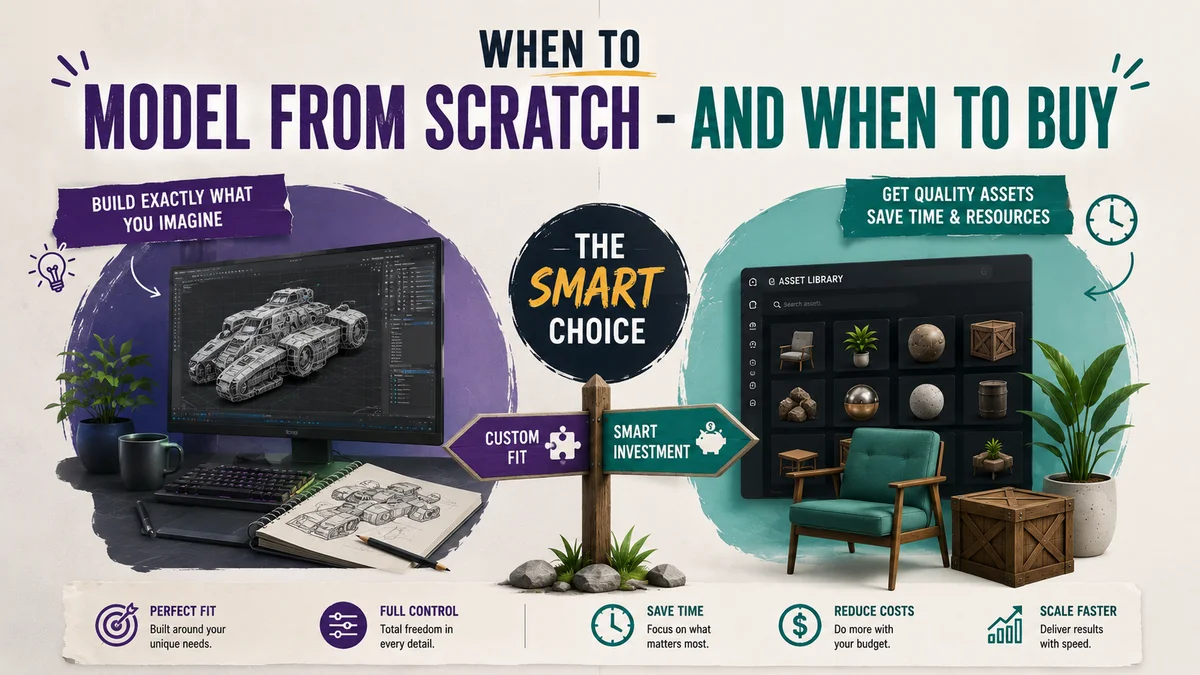
Model From Scratch When:
The asset is a hero piece that defines the project's visual identity. The main character of a game. The signature product in a product render. The architectural feature that makes a building unique. These hero assets are the creative work that clients hire you for. They should be custom.
The asset has a very specific brief that no existing asset can satisfy. Client needs a branded coffee cup with exact dimensions and specific label design. No marketplace asset will work. Model it.
The asset will be seen in extreme close-up or used as the subject of a showcase render. When an asset fills the entire frame and the audience has time to examine every polygon, only a custom-built asset with obsessive attention to detail will suffice.
You need full control over the underlying geometry for technical reasons. Character meshes that need specific edge loops for facial animation. Game assets that need a very specific polygon budget. Simulation assets that need clean geometry for VFX work. Build these.
You are in learning mode. Students and beginners should model as much as possible. Every asset is a lesson.
Buy or Source From a Library When:
The asset is a background or supporting element. Background buildings, street furniture, vegetation, generic props, secondary characters, filler objects. These fill the world but are not the world. They do not need to be custom.
You need multiple variations of the same category. If your scene needs fifteen different tree varieties, buying a tree library is almost always faster and higher quality than modeling fifteen trees from scratch.
The asset type has mature, high-quality options available. Furniture, vehicles, architecture, plants, rocks, and ground surfaces all have extraordinary pre-made options available. Reinventing these is almost never justified.
You are working under a time or budget constraint. When the deadline is fixed and the scope is large, the professional response is to identify which assets can be sourced and focus custom modeling effort on the assets that truly require it.
The asset needs to be ready today. A client needs a preview render by end of day. You need a conference room full of furniture, a city street, and a handful of vehicles. You are not modeling those. You are sourcing them.
What Buying 3D Assets Actually Looks Like in Professional Pipelines
If buying assets still feels like a shortcut rather than a professional practice, consider how studios at every scale actually work.
Indie Game Development
Every successful indie game studio uses asset libraries. The question is never whether to use pre-made assets, it is how to use them intelligently. Games like Hollow Knight, Stardew Valley, and dozens of successful indie titles were made by tiny teams who were ruthlessly strategic about where they spent their modeling hours. Custom work went into the assets that defined the game's art direction. Everything else was sourced.
Architectural Visualization
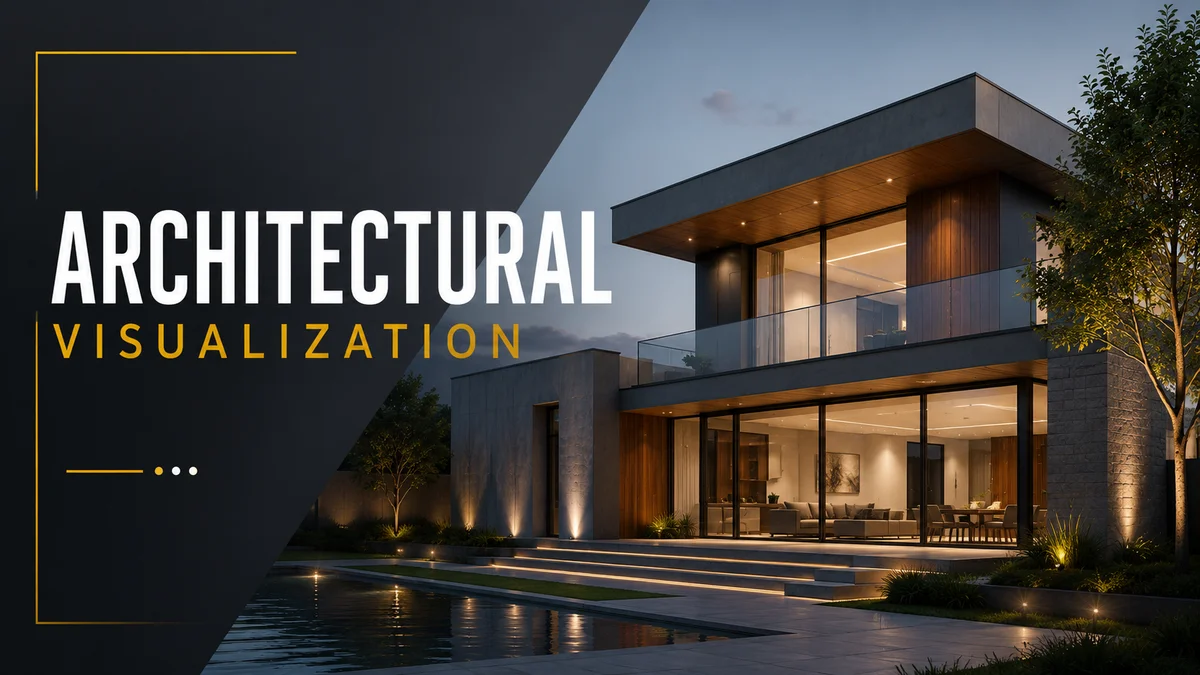
ArchViz studios exist almost entirely because of asset libraries. A studio producing twenty photorealistic interior renders per month does not have twenty teams of modelers building furniture from scratch. They have a curated library of thousands of photorealistic furniture, fixture, and decor assets that get placed, lit, and rendered. The creative work is in the staging, lighting, and composition, not in modeling a sofa for the fourteenth time.
Film and VFX
Even the largest VFX studios with hundreds of artists use asset libraries for background and environment dressing. The hero spaceship gets custom modeled. The hundreds of asteroids filling the background of the space battle get sourced from a procedural or pre-made library. Production economics demand it.
Motion Design and Advertising
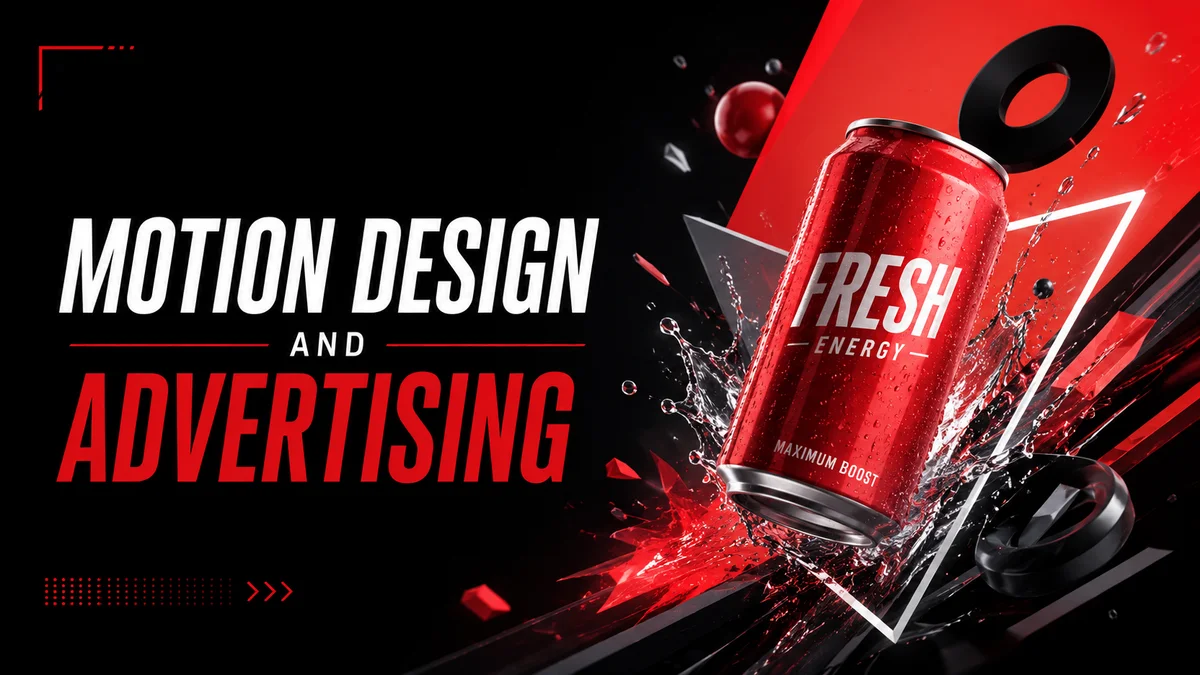
Motion designers and advertising agencies are perhaps the most prolific users of 3D asset libraries. Campaigns run on tight timelines and tight budgets. Pre-made assets let small teams produce high-quality 3D content at a pace that would be completely impossible if everything were custom.
The Math: Subscription vs. Modeling Time
Let us do the numbers on a real-world scenario.
Scenario: A freelance 3D artist is producing an architectural visualisation of a luxury apartment. The scene needs:
8 furniture pieces (sofa, chairs, tables, shelving)
1 kitchen with appliances
Decorative objects (plants, books, art, lighting)
Flooring and wall materials
If modeled from scratch:
Asset Category | Est. Hours |
|---|
8 furniture pieces | 24 hours |
Kitchen with appliances | 16 hours |
Decorative objects | 10 hours |
Materials and textures | 8 hours |
Total | 58 hours |
At ₹2,000/hour billable rate, that is ₹1,16,000 in time spent on assets alone, before a single render has been set up.
If sourced from a subscription library:
Cost | Amount |
|---|
Korvix3D Pro subscription | ₹999/month |
Time to source and import assets | 3–4 hours |
Time saved | ~54 hours |
Money saved (at ₹2,000/hr) | ~₹1,08,000 |
The subscription pays for itself approximately 100 times over on a single project of this scale. And the sourced assets, made by specialists who have spent years perfecting photorealistic furniture, will likely match or exceed the quality of assets modeled under time pressure by a generalist.
The Hybrid Approach: How Smart Artists Actually Work
The most effective 3D artists do not choose between modeling and buying. They build a deliberate hybrid workflow:
Identify hero assets first. At the start of every project, identify the five to ten assets that will define the visual identity. These get custom modeled with full attention.
Source everything else. Everything that fills the world but does not define it gets sourced from a library. Fast, high quality, and delivered directly into your scene via bridge plugin.
Customise sourced assets where needed. A sourced building can have its textures swapped. A sourced character can have its rig modified. You are not locked into assets as delivered, you can modify them to fit your brief.
Build a personal library over time. Custom assets you build for one project become library assets for future projects. Over time your personal library fills in the gaps that marketplace libraries do not cover, and your studio develops a distinctive visual language without reinventing common assets.
Choosing the Right Source for Pre-Made Assets
Not all asset sources are equal. The key factors to evaluate:
Quality consistency. A marketplace where quality varies wildly from asset to asset will slow you down with failed imports and unusable files. Look for platforms with consistent quality standards and curation.
Workflow integration. Manually downloading, converting formats, and reconnecting textures is its own productivity drain. A platform with native bridge plugins for your DCC tools, delivering assets directly into your scene in one click, eliminates this overhead entirely.
Format availability. Ensure the platform provides assets in the formats your pipeline requires. FBX, OBJ, and GLTF at minimum.
Licensing clarity. Every sourced asset introduces a licensing obligation. Use platforms with clear, straightforward commercial licenses that cover professional use.
Cost model. Per-asset pricing works for occasional purchases. For studios and artists with high-volume needs, a subscription model is dramatically more cost-effective. At ₹999/month for unlimited access to a premium library, the economics of subscription vs. per-asset vs. modeling-time are not remotely close.
At Korvix3D, every asset comes with a clear commercial license, is available through native bridge plugins for Blender, Maya, Houdini, Cinema4D, and 3DS Max, and is accessible on a subscription that costs less than a single hour of most freelancers' billable time.
[Explore the full asset library →] https://www.korvix3d.com/assets
[See the bridge plugin workflow →] https://www.korvix3d.com/docs/plugins
Frequently Asked Questions
Is buying 3D assets considered cheating? No, and this question reflects a misconception about professional creative work. Architects do not manufacture their own materials. Photographers do not build their own cameras. Filmmakers do not sew their own costumes. Using the best available tools and resources to produce the best possible output is the definition of professionalism. Modeling from scratch when a superior pre-made asset exists is not more skilled, it is less efficient.
Does using pre-made assets mean my work looks generic? Only if you use assets without customisation or curation. Pre-made assets are raw material, not finished work. The scene composition, lighting, camera work, color grading, and creative direction are what make work distinctive, and those cannot be bought. Artists who understand this produce highly original work with sourced assets.
What if the asset is not quite right for my scene? Modify it. Pre-made assets are not locked. Swap textures, adjust scale, change materials, modify geometry where needed. Think of sourced assets as a strong starting point, not a final deliverable.
Will clients know I used pre-made assets? Almost certainly not, and it does not matter if they do. Clients are buying results, the quality of the final render, the accuracy of the visualisation, the impact of the design. How you produced those results is your professional business, not theirs.
When does it make sense to model an asset even if a pre-made version exists? When the pre-made version is genuinely not good enough for the specific use case, when you need full technical control over the geometry, when the asset is a hero piece central to the project, or when you are deliberately practicing and building skill.
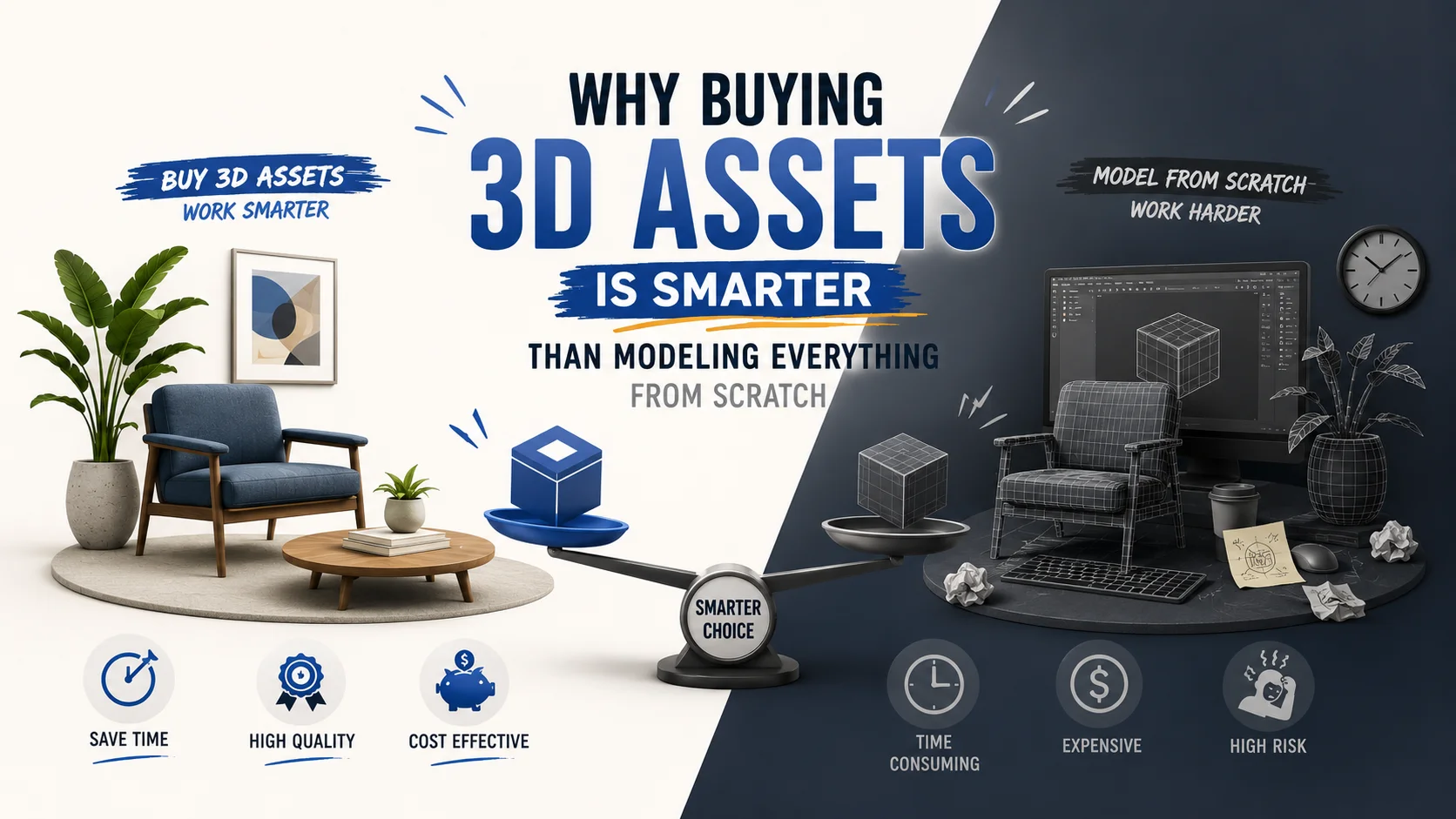

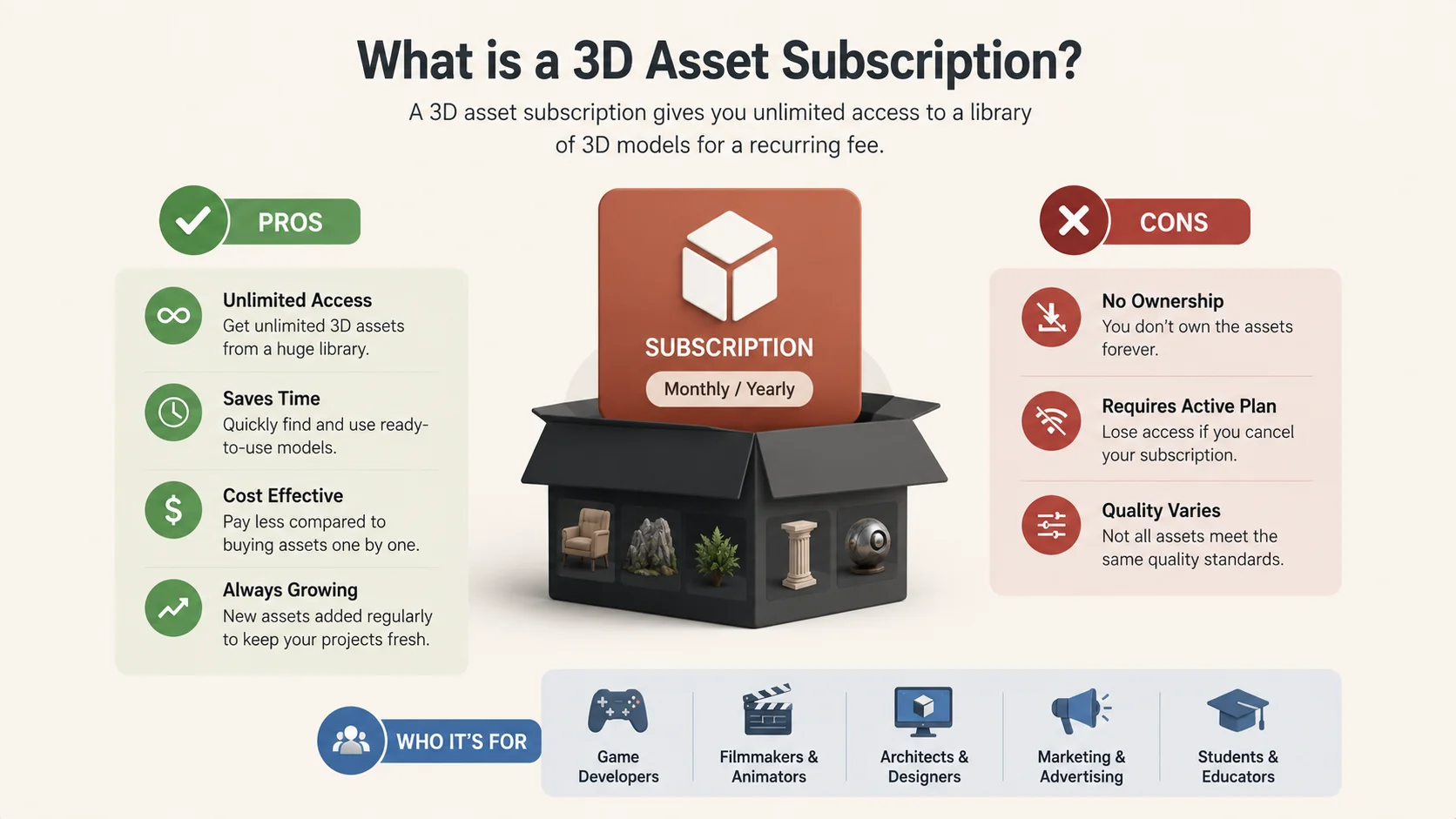
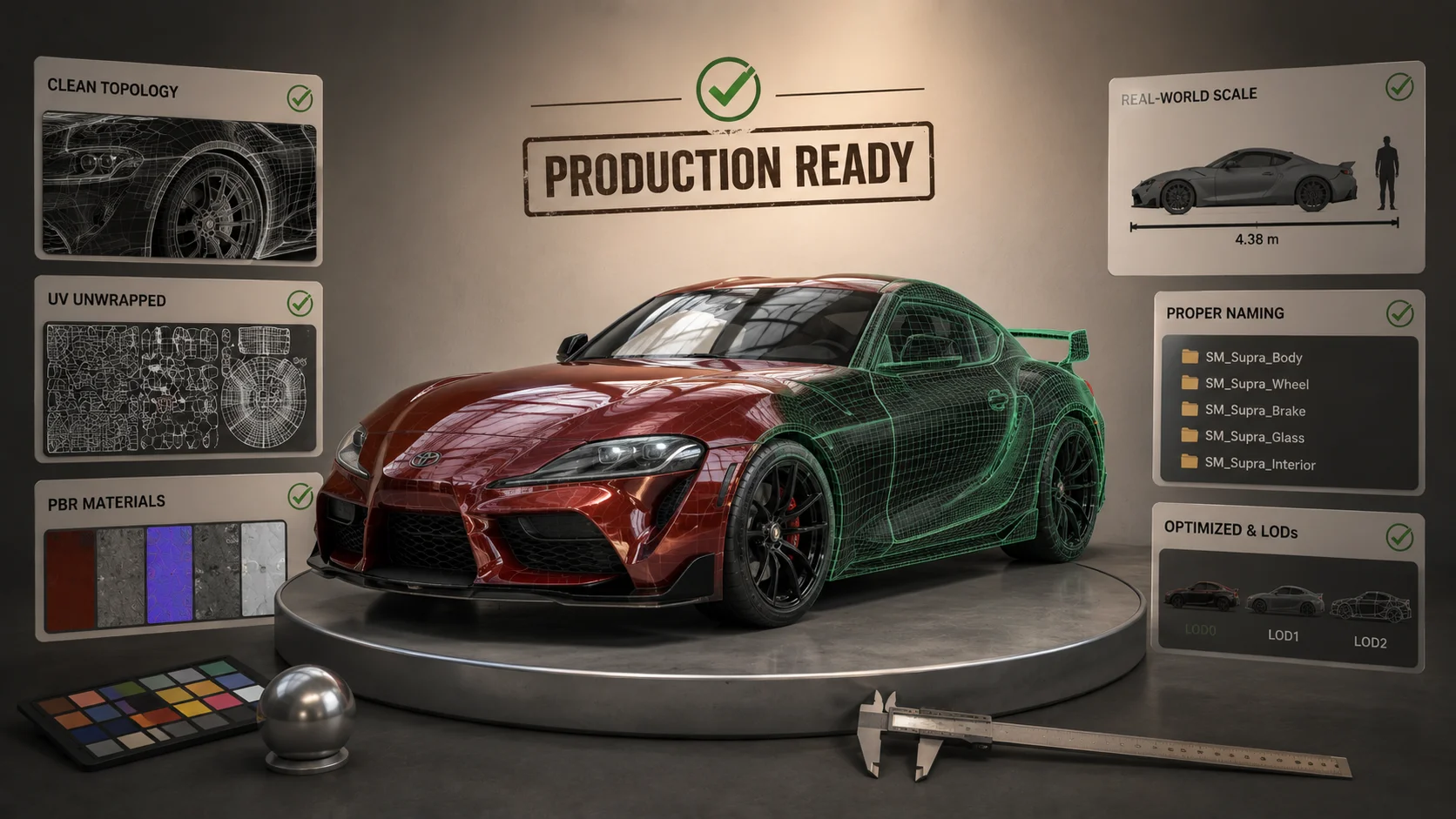
Every 3D artist has been there.
You are deep in a project, a game level, an architectural render, a product visualisation, and your scene needs a park bench. Nothing fancy. Just a park bench.
You open your DCC tool and start modeling. Two hours later you have a park bench. It looks fine. But you just spent two hours of your creative energy on a park bench, an object that will occupy roughly forty pixels in the background of your final render and will never once be the reason a client chooses your work over a competitor's.
This is the "model everything from scratch" trap. And it is quietly costing 3D artists and studios thousands of hours every year.
This article is not an argument against learning to model. Modeling is a core skill and developing it makes you a better artist. This is an argument about how to use that skill strategically, so you spend your finite creative hours on the work that actually moves the needle, rather than rebuilding objects that already exist perfectly in a library somewhere.
The Hidden Cost of Modeling Everything Yourself
Most artists instinctively feel that modeling their own assets is the "right" way to work. It feels more professional. More legitimate. More skilled. Buying assets can feel like cheating.
That instinct is understandable. It is also, in most professional contexts, completely wrong. Here is why.
Your Time Has a Real Dollar Value
Whether you are a freelancer, a studio employee, or an indie developer, your time converts directly to money. A freelance 3D generalist billing at ₹2,000 per hour who spends three hours modeling a chair that is available as a premium asset for ₹400 has not saved ₹400, they have lost ₹5,600 in billable time.
This calculation changes everything. The question is never "why would I pay for something I can make myself?" The real question is always: "what is the best possible use of the next hour of my time?"
The Compounding Problem
The time cost of modeling everything is not a one-time issue, it compounds. A game environment might need 200 unique props. A product visualisation studio might produce 50 scenes per month. An animation studio might need 500 assets across a single production.
At those volumes, the time cost of modeling everything from scratch does not just slow you down. It makes entire categories of project economically impossible.
Quality at Scale Is Extremely Hard
Here is an uncomfortable truth about modeling your own assets at scale: maintaining consistent quality across a large library is genuinely difficult and time-consuming. A hero prop that you spend twelve hours on will be stunning. The fortieth background prop you model when you are rushing toward a deadline will not be.
Professional asset creators who specialise in specific asset categories have an enormous quality advantage on those assets. A creator who has spent years making photorealistic furniture assets will produce a better chair faster than a generalist who models furniture once a month.
The "But I Need to Learn" Argument - Addressed
Before going further, let us address the most legitimate counterargument directly: modeling is a skill, and you build it by doing it. Buying assets instead of modeling means you practice less.
This is true. And it matters at the right time.
If you are a student or a beginner, modeling everything you can is the right approach. You are in skill-building mode. Your time is invested in developing capability, not delivering client work. Model the chair, the car, the building facade. Learn topology, UV unwrapping, PBR texturing. Build the foundation.
But the moment you are working on a project with a real deadline, a real client, or a real budget, you have shifted from learning mode to delivery mode. In delivery mode, the goal is the best possible output in the available time. And in delivery mode, modeling a park bench for two hours is rarely the best use of your time.
The most effective professional approach is not "model everything" or "buy everything." It is knowing exactly which assets to build and which to buy, and having the discipline to make that call quickly on every project.
When to Model From Scratch - And When to Buy
Here is the decision framework that professional artists and studios actually use:
Model From Scratch When:
The asset is a hero piece that defines the project's visual identity. The main character of a game. The signature product in a product render. The architectural feature that makes a building unique. These hero assets are the creative work that clients hire you for. They should be custom.
The asset has a very specific brief that no existing asset can satisfy. Client needs a branded coffee cup with exact dimensions and specific label design. No marketplace asset will work. Model it.
The asset will be seen in extreme close-up or used as the subject of a showcase render. When an asset fills the entire frame and the audience has time to examine every polygon, only a custom-built asset with obsessive attention to detail will suffice.
You need full control over the underlying geometry for technical reasons. Character meshes that need specific edge loops for facial animation. Game assets that need a very specific polygon budget. Simulation assets that need clean geometry for VFX work. Build these.
You are in learning mode. Students and beginners should model as much as possible. Every asset is a lesson.
Buy or Source From a Library When:
The asset is a background or supporting element. Background buildings, street furniture, vegetation, generic props, secondary characters, filler objects. These fill the world but are not the world. They do not need to be custom.
You need multiple variations of the same category. If your scene needs fifteen different tree varieties, buying a tree library is almost always faster and higher quality than modeling fifteen trees from scratch.
The asset type has mature, high-quality options available. Furniture, vehicles, architecture, plants, rocks, and ground surfaces all have extraordinary pre-made options available. Reinventing these is almost never justified.
You are working under a time or budget constraint. When the deadline is fixed and the scope is large, the professional response is to identify which assets can be sourced and focus custom modeling effort on the assets that truly require it.
The asset needs to be ready today. A client needs a preview render by end of day. You need a conference room full of furniture, a city street, and a handful of vehicles. You are not modeling those. You are sourcing them.
What Buying 3D Assets Actually Looks Like in Professional Pipelines
If buying assets still feels like a shortcut rather than a professional practice, consider how studios at every scale actually work.
Indie Game Development
Every successful indie game studio uses asset libraries. The question is never whether to use pre-made assets, it is how to use them intelligently. Games like Hollow Knight, Stardew Valley, and dozens of successful indie titles were made by tiny teams who were ruthlessly strategic about where they spent their modeling hours. Custom work went into the assets that defined the game's art direction. Everything else was sourced.
Architectural Visualization
ArchViz studios exist almost entirely because of asset libraries. A studio producing twenty photorealistic interior renders per month does not have twenty teams of modelers building furniture from scratch. They have a curated library of thousands of photorealistic furniture, fixture, and decor assets that get placed, lit, and rendered. The creative work is in the staging, lighting, and composition, not in modeling a sofa for the fourteenth time.
Film and VFX
Even the largest VFX studios with hundreds of artists use asset libraries for background and environment dressing. The hero spaceship gets custom modeled. The hundreds of asteroids filling the background of the space battle get sourced from a procedural or pre-made library. Production economics demand it.
Motion Design and Advertising
Motion designers and advertising agencies are perhaps the most prolific users of 3D asset libraries. Campaigns run on tight timelines and tight budgets. Pre-made assets let small teams produce high-quality 3D content at a pace that would be completely impossible if everything were custom.
The Math: Subscription vs. Modeling Time
Let us do the numbers on a real-world scenario.
Scenario: A freelance 3D artist is producing an architectural visualisation of a luxury apartment. The scene needs:
8 furniture pieces (sofa, chairs, tables, shelving)
1 kitchen with appliances
Decorative objects (plants, books, art, lighting)
Flooring and wall materials
If modeled from scratch:
Asset Category
Est. Hours
8 furniture pieces
24 hours
Kitchen with appliances
16 hours
Decorative objects
10 hours
Materials and textures
8 hours
Total
58 hours
At ₹2,000/hour billable rate, that is ₹1,16,000 in time spent on assets alone, before a single render has been set up.
If sourced from a subscription library:
Cost
Amount
Korvix3D Pro subscription
₹999/month
Time to source and import assets
3–4 hours
Time saved
~54 hours
Money saved (at ₹2,000/hr)
~₹1,08,000
The subscription pays for itself approximately 100 times over on a single project of this scale. And the sourced assets, made by specialists who have spent years perfecting photorealistic furniture, will likely match or exceed the quality of assets modeled under time pressure by a generalist.
The Hybrid Approach: How Smart Artists Actually Work
The most effective 3D artists do not choose between modeling and buying. They build a deliberate hybrid workflow:
Identify hero assets first. At the start of every project, identify the five to ten assets that will define the visual identity. These get custom modeled with full attention.
Source everything else. Everything that fills the world but does not define it gets sourced from a library. Fast, high quality, and delivered directly into your scene via bridge plugin.
Customise sourced assets where needed. A sourced building can have its textures swapped. A sourced character can have its rig modified. You are not locked into assets as delivered, you can modify them to fit your brief.
Build a personal library over time. Custom assets you build for one project become library assets for future projects. Over time your personal library fills in the gaps that marketplace libraries do not cover, and your studio develops a distinctive visual language without reinventing common assets.
Choosing the Right Source for Pre-Made Assets
Not all asset sources are equal. The key factors to evaluate:
Quality consistency. A marketplace where quality varies wildly from asset to asset will slow you down with failed imports and unusable files. Look for platforms with consistent quality standards and curation.
Workflow integration. Manually downloading, converting formats, and reconnecting textures is its own productivity drain. A platform with native bridge plugins for your DCC tools, delivering assets directly into your scene in one click, eliminates this overhead entirely.
Format availability. Ensure the platform provides assets in the formats your pipeline requires. FBX, OBJ, and GLTF at minimum.
Licensing clarity. Every sourced asset introduces a licensing obligation. Use platforms with clear, straightforward commercial licenses that cover professional use.
Cost model. Per-asset pricing works for occasional purchases. For studios and artists with high-volume needs, a subscription model is dramatically more cost-effective. At ₹999/month for unlimited access to a premium library, the economics of subscription vs. per-asset vs. modeling-time are not remotely close.
At Korvix3D, every asset comes with a clear commercial license, is available through native bridge plugins for Blender, Maya, Houdini, Cinema4D, and 3DS Max, and is accessible on a subscription that costs less than a single hour of most freelancers' billable time.
[Explore the full asset library →] https://www.korvix3d.com/assets
[See the bridge plugin workflow →] https://www.korvix3d.com/docs/plugins
Frequently Asked Questions
Is buying 3D assets considered cheating? No, and this question reflects a misconception about professional creative work. Architects do not manufacture their own materials. Photographers do not build their own cameras. Filmmakers do not sew their own costumes. Using the best available tools and resources to produce the best possible output is the definition of professionalism. Modeling from scratch when a superior pre-made asset exists is not more skilled, it is less efficient.
Does using pre-made assets mean my work looks generic? Only if you use assets without customisation or curation. Pre-made assets are raw material, not finished work. The scene composition, lighting, camera work, color grading, and creative direction are what make work distinctive, and those cannot be bought. Artists who understand this produce highly original work with sourced assets.
What if the asset is not quite right for my scene? Modify it. Pre-made assets are not locked. Swap textures, adjust scale, change materials, modify geometry where needed. Think of sourced assets as a strong starting point, not a final deliverable.
Will clients know I used pre-made assets? Almost certainly not, and it does not matter if they do. Clients are buying results, the quality of the final render, the accuracy of the visualisation, the impact of the design. How you produced those results is your professional business, not theirs.
When does it make sense to model an asset even if a pre-made version exists? When the pre-made version is genuinely not good enough for the specific use case, when you need full technical control over the geometry, when the asset is a hero piece central to the project, or when you are deliberately practicing and building skill.